Last reviewed: 14 October 2026
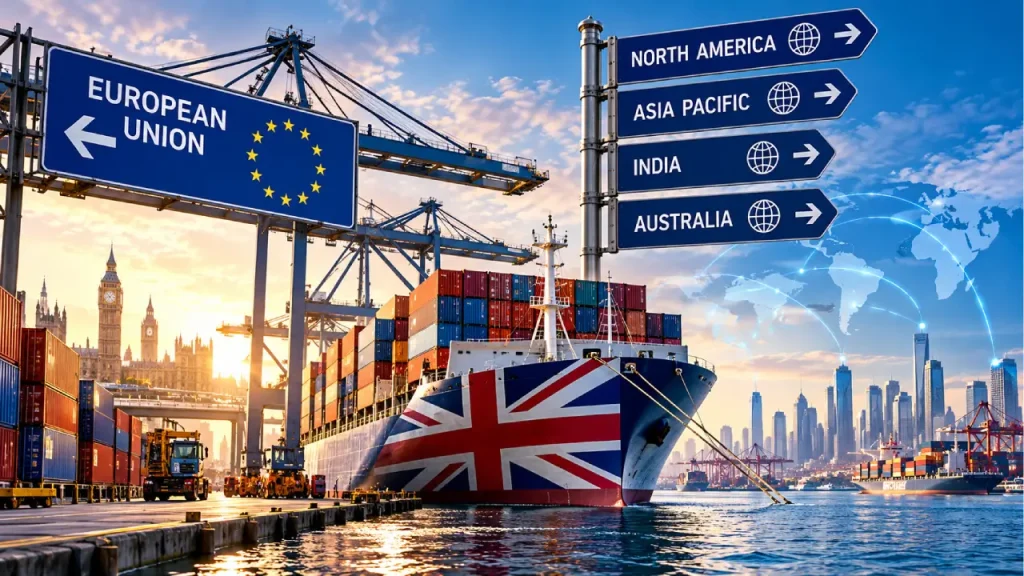
Brexit and trade were closely linked in the case for leaving the European Union. Outside the EU, the United Kingdom would once again control its own trade policy, set its own tariffs and negotiate trade agreements in its own name.
That part is clear: the UK did regain an independent trade policy.
The harder question is whether that freedom produced the wider economic gains associated with a more outward-looking “Global Britain” — and whether new trade opportunities have been large enough to offset the additional barriers created in trade with the European Union.
This Brexit File examines what changed, what new agreements have actually been secured, how UK–EU trade has performed and what the latest official evidence says.
Brexit and Trade at a Glance
- The UK can now negotiate and sign trade agreements independently of the EU.
- Australia, New Zealand and India are important examples of genuinely new post-Brexit agreements, while the UK has also joined CPTPP.
- Many other agreements are continuity deals replacing arrangements Britain previously had through EU membership.
- The EU remains the UK’s largest trading partner, accounting for 41% of exports and around half of imports in 2025.
- The OBR continues to estimate that the post-Brexit trading relationship will reduce long-run productivity by 4% relative to remaining in the EU.
The central distinction is important: Brexit delivered greater control over trade policy. That is not automatically the same thing as delivering more trade.
What Was “Global Britain” Supposed to Mean?
“Global Britain” was primarily a post-referendum government vision rather than a specific proposition on the 2016 ballot paper.
The idea was that leaving the EU would allow the UK to become more agile in international trade: setting its own priorities, negotiating its own agreements and developing closer commercial relationships with faster-growing markets outside Europe.
In January 2017, Prime Minister Theresa May argued that a “Global Britain” needed to be free to strike trade agreements with countries outside the EU. Later that year, the government’s Trade White Paper described Brexit as an opportunity for Britain to have its own independent trade policy for the first time in more than 40 years. GOV.UK
The ambition contained two goals that were always going to be difficult to balance.
The first was greater freedom to make trade agreements around the world.
The second was keeping trade with the EU as frictionless as possible.
Those objectives matter because the EU is geographically close, deeply integrated with UK supply chains and was already Britain’s largest trading partner. Leaving the EU customs union and single market gave the UK the freedom to run an independent trade policy, but it also meant leaving arrangements that had removed many customs and regulatory barriers with Europe.
Northern Ireland became the clearest example of how Brexit’s new trading arrangements could create different rules and checks within the United Kingdom.
That trade-off lies at the heart of any fair assessment of Brexit and trade.
The same trade-off was especially visible in fishing, where greater control over UK waters still had to be balanced against access to European markets.
What Trade Powers Did Brexit Return to the UK?
Before Brexit, international trade negotiations were conducted through the European Union. Britain helped shape EU trade policy as a Member State but could not independently negotiate and conclude its own comprehensive free trade agreements.
After Brexit, the UK regained the ability to negotiate bilateral and regional agreements in its own name, establish its own external tariff regime, operate its own trade-remedies system and join agreements such as the Comprehensive and Progressive Agreement for Trans-Pacific Partnership.
This is a genuine change in sovereignty.
It means agreements with Australia, New Zealand and India, together with membership of CPTPP, were pursued through an independent British trade policy.
That is one of the clearest areas in which a stated objective of Brexit was achieved. House of Commons Library
But measuring the value of that change requires another question:
What did Britain do with the freedom it regained?
Not Every Post-Brexit Trade Agreement Is New
Large numbers are sometimes quoted for the number of trade agreements Britain has signed since Brexit.
Those figures require context.
The House of Commons Library reported in 2026 that the UK Government had signed 40 trade agreements covering 74 countries and territories plus the EU, with agreements in force for 73 partners.
However, most are rollover or continuity agreements replacing arrangements from which the UK previously benefited through EU membership. House of Commons Library
Those agreements are important. Without them, existing preferential trading relationships could have been disrupted following Brexit.
But maintaining existing trading preferences is not the same as gaining entirely new market access because Britain left the EU.
The genuinely new post-Brexit picture includes agreements with Australia, New Zealand and India, accession to CPTPP and a number of new or updated digital and bilateral arrangements.
That distinction matters whenever claims are made about the number of “new Brexit trade deals”.
The Australia Trade Agreement
The UK–Australia Free Trade Agreement was the first agreement the UK negotiated from scratch after Brexit. It entered into force in May 2023.
The government estimated that the deal could increase UK–Australia bilateral trade by around £10.4 billion in the long run compared with projected trade without the agreement.
Its central modelling estimated a long-run increase in UK GDP of approximately 0.08%, equivalent to around £2.3 billion using the prices and assumptions in the assessment. GOV.UK
That is a positive economic effect.
The agreement also generated concerns among some British farmers about increased competition from Australian agricultural products. That illustrates an often overlooked feature of trade agreements: even an agreement expected to benefit the economy overall can create different effects across industries.
For the purposes of this Brexit File, however, the Australia agreement represents a genuine exercise of Britain’s new trade autonomy.
The New Zealand Trade Agreement
The UK–New Zealand Free Trade Agreement also entered into force in 2023.
The government’s modelling estimated that bilateral trade could eventually be around £1.7 billion higher than without the agreement.
The central estimate for UK GDP was an increase of approximately 0.03%, equivalent to about £0.8 billion under the modelling assumptions. GOV.UK
Again, that represents a genuine economic benefit.
It is also relatively small compared with the size of the overall British economy.
Joining the CPTPP
Britain has also joined the Comprehensive and Progressive Agreement for Trans-Pacific Partnership, linking the UK with economies across the Asia-Pacific and the Americas.
The Department for Business and Trade estimates that UK accession could increase trade with CPTPP members by around £4.9 billion in the long run compared with projected trade without accession.
The government estimates a long-run increase in UK GDP of around £2 billion a year. GOV.UK
There is an important qualification.
Britain already had trade agreements with several CPTPP members. The government’s central assessment therefore attempts to measure the additional benefit of CPTPP membership above existing agreements.
CPTPP may ultimately become more economically important if additional economies join. The government itself emphasises this potential strategic value.
But future expansion should be distinguished from economic gains already achieved.
The India Trade Agreement
The UK–India Comprehensive Economic and Trade Agreement is potentially one of the most important new agreements concluded since Brexit.
It entered into force on 15 July 2026. GOV.UK
India is a far larger and faster-growing market than Australia or New Zealand.
The Department for Business and Trade estimates that, in the long run, the agreement could increase UK exports to India by almost 60%, imports from India by around 25% and total bilateral trade by approximately £25.5 billion annually.
Its modelling estimates that UK GDP could ultimately be around 0.13% higher, equivalent to approximately £4.8 billion a year relative to a projected 2040 economy without the agreement. GOV.UK
Those figures are projections, not observed results.
The agreement has only recently entered into force, so it is much too early to determine whether those gains will be realised.
Nevertheless, India provides an important example of the sort of independent trade agreement Brexit made possible.
What About a United States Trade Deal?
A comprehensive UK–US free trade agreement was one of the prominent aspirations discussed following the referendum.
Negotiations began in 2020 but did not produce a comprehensive FTA.
In 2025 Britain and the United States instead agreed the general terms of an Economic Prosperity Deal. The House of Commons Library described that arrangement in July 2026 as non-binding and only partially implemented. House of Commons Library
That does not diminish the importance of UK–US trade.
But the comprehensive free trade agreement once envisaged has not materialised.
The EU Is Still Britain’s Largest Trading Partner
The opportunity to expand trade outside Europe was central to the Global Britain argument.
But geography and existing economic integration continue to matter.
In 2025, the EU accounted for 41% of UK exports of goods and services and approximately half of imports. The EU’s share of UK exports has remained broadly within a 41%–44% range since 2015. House of Commons Library
Britain therefore has not simply replaced European trade with trade elsewhere in the world.
The European market remains central to the British economy.
Goods and Services Tell Different Stories
An important warning is needed when discussing Brexit and trade: trade is not one single thing.
Goods and services have followed markedly different paths.
House of Commons Library figures show that, in real terms, UK goods exports to the EU in 2025 were 14% below their 2019 level. But goods exports to non-EU countries were also around 8% below 2019.
Services performed much better. UK services exports to the EU were 28% above 2019 levels, while services exports to non-EU markets were 26% higher. House of Commons Library
That matters for two reasons.
First, the weakness in goods exports cannot simply be attributed entirely to Brexit. The pandemic, Russia’s invasion of Ukraine, energy prices, supply-chain disruption and other economic changes also affected international trade.
Second, the strong performance of services demonstrates that Brexit did not produce a universal decline in British exports.
A credible assessment therefore has to acknowledge both facts:
Goods trade has struggled. Services trade has performed considerably better.
What Changed in Trade With the EU?
The UK–EU Trade and Cooperation Agreement avoided the most disruptive possible outcome.
Goods satisfying the appropriate rules of origin can generally move between the UK and EU without tariffs.
But tariff-free trade is not the same as frictionless trade.
Businesses trading across the UK–EU border can now face customs procedures, rules-of-origin requirements, regulatory compliance, health and agricultural certification and other administrative obligations that were absent or considerably lighter within the EU single market and customs union. GOV.UK
This matters especially with a nearby market integrated into British manufacturing, food production and supply chains.
The Trade and Cooperation Agreement therefore maintained very extensive market access while creating greater non-tariff friction than existed under EU membership.
What Does the OBR Say?
The Office for Budget Responsibility is Britain’s independent fiscal watchdog, and its assumptions are used when producing the official economic forecasts underpinning the public finances.
Its March 2026 forecast continues to assume that the post-Brexit trading relationship with the EU will reduce long-run UK productivity by 4% compared with remaining in the EU.
It also assumes exports and imports will eventually be about 15% lower than they would have been had Britain remained a member. Office for Budget Responsibility
The OBR attributes much of that effect to increased non-tariff barriers to UK–EU trade.
It also currently judges that new non-EU trade agreements are unlikely to have a sufficiently large effect to materially change that central forecast. Office for Budget Responsibility
These figures require care.
The OBR compares reality with a hypothetical alternative in which Britain remained in the EU. That counterfactual can never be directly observed.
The OBR itself acknowledges that disentangling Brexit from the pandemic, the energy shock, Russia’s invasion of Ukraine and other developments is extremely difficult. Office for Budget Responsibility
Nevertheless, the 4% assumption remains its current central judgement.
Can We Simply Compare the 4% Brexit Estimate With the New Trade Deals?
No.
It might be tempting to take the OBR’s 4% productivity estimate, place it alongside the 0.08% Australia estimate, 0.03% New Zealand estimate and 0.13% India estimate, add the latter together and announce the result.
That would be misleading.
They are not measuring exactly the same thing.
The OBR estimate concerns the long-term effect of the overall post-Brexit trading relationship relative to continued EU membership.
The individual trade-deal estimates generally compare each agreement with a scenario in which that particular agreement did not exist.
CPTPP modelling additionally attempts to isolate the value of accession above agreements Britain already had with several CPTPP members.
The estimates also use different base years, prices and assumptions.
They can help indicate orders of magnitude, but they cannot sensibly be treated as entries in a single balance sheet.
What they do show is that the government expects the new agreements to generate economic gains while the OBR still expects the economic effect of additional barriers with the EU to be substantially larger. Office for Budget Responsibility
The Strongest Argument in Favour of the New Trade Policy
Supporters of Brexit can reasonably argue that an independent trade policy should not be judged solely on agreements concluded during its first few years.
Trade relationships develop over decades.
India may grow substantially. CPTPP could expand. Digital trade could become increasingly important. Future governments may negotiate agreements more valuable than those reached so far.
Britain also now has the freedom to determine its own priorities and decide which compromises it is willing to make in trade negotiations rather than forming part of a common policy agreed between 27 EU Member States.
Economic modelling cannot capture every possible future effect of investment, technological change, regulation and supply chains.
Those are legitimate arguments.
But they describe potential future gains.
They do not yet demonstrate that Britain’s new trading model has produced a net economic gain compared with continued EU membership.
The Strongest Argument Against the New Trading Model
The principal counterargument is geography.
Countries tend to trade heavily with nearby economies because transport is cheaper, supply chains can be integrated and repeated transactions are easier.
EU membership provided Britain with an unusually deep form of economic integration combining tariff-free trade, a customs union, common regulatory frameworks and extensive access to the single market.
A conventional free trade agreement does not reproduce that degree of integration.
That means a valuable agreement with a distant economy can coexist with economically significant additional friction affecting trade with a much larger nearby market.
The EU’s continued importance in Britain’s trade figures shows how difficult that relationship is to replace.
Britain Is Now Trying to Reduce Some EU Trade Friction
The story is still developing.
In May 2025, Britain and the EU agreed to pursue a new sanitary and phytosanitary agreement covering many rules affecting food, plants and animal products.
The government expects such an agreement to remove substantial routine documentation and border checks affecting agrifood trade.
As of October 2026, negotiations remain underway. Government guidance says implementation is intended for around mid-2027, subject to the negotiations being completed. GOV.UK
That development illustrates an important change in the practical Brexit debate.
Britain is attempting to retain an independent trade policy while rebuilding closer arrangements with the EU in areas where post-Brexit friction has proved costly.
That is not the same thing as reversing Brexit.
But it does show that policy is increasingly concerned not with whether new barriers exist, but with how many Britain should remove.
So, Did “Global Britain” Deliver?
Did Brexit give Britain control of its own trade policy?
Yes.
Britain can negotiate its own agreements, establish its own tariffs and determine its own trade priorities.
That objective was delivered.
Has Britain used that freedom to secure new agreements?
Yes.
Australia, New Zealand, CPTPP and India are important examples.
It would be inaccurate to say Brexit created no new international trading opportunities.
Were all the trade agreements announced since Brexit genuinely new?
No.
Most of the agreements included in headline totals are continuity arrangements replacing agreements Britain previously enjoyed through EU membership. House of Commons Library
Has British trade shifted decisively away from Europe?
No.
The EU still accounts for around two-fifths of exports and approximately half of imports. House of Commons Library
Have the new global agreements been shown to compensate for increased barriers with the EU?
Not on the evidence currently available.
The new agreements are expected to produce genuine benefits, but the OBR continues to forecast a considerably larger long-term economic effect from the increase in UK–EU trade barriers.
At the same time, Britain’s strong services performance and the difficulty of separating Brexit from other global shocks mean the evidence is more complicated than the simple claim that Brexit “destroyed British trade”.
The Brexit Files Verdict
Brexit delivered trade-policy sovereignty. It has also produced genuine new trade agreements and opportunities.
What has not yet been demonstrated is that those gains outweigh the additional costs of trading with Britain’s largest and closest market.
The most defensible conclusion in 2026 is therefore neither that Global Britain was entirely imaginary nor that it has clearly delivered the economic transformation its advocates hoped for.
Britain exchanged deeper integration with its largest market for greater freedom to pursue agreements elsewhere.
The freedom is real.
The economic dividend remains much less certain.