Last reviewed: 17 October 2026
One of the most persistent arguments for Brexit was that leaving the European Union would free British businesses from unnecessary regulation.
Outside the EU, Parliament could change rules that no longer suited the UK, regulators could design systems around British priorities, and businesses would no longer have to live with every decision made in Brussels.
That freedom is real.
But Brexit also changed something equally important for business: trade with the EU stopped being trade inside a single market and customs union and became trade across an international border.
Northern Ireland became a special case, with post-Brexit arrangements creating different rules and checks for some goods moving from Great Britain.
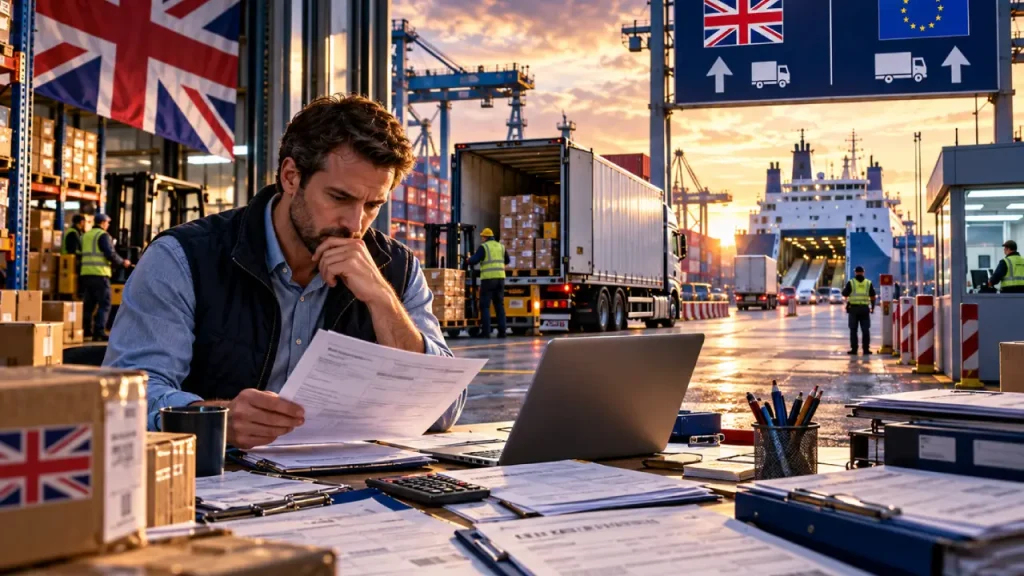
For many companies, particularly those moving goods between Great Britain and the EU, that brought customs declarations, rules-of-origin requirements, regulatory checks and other procedures that did not previously exist.
So did Brexit cut red tape?
The answer depends heavily on what kind of business we are talking about — and on the difference between freedom to regulate differently and the amount of administration a business actually has to complete.
Brexit and Business at a Glance
- Britain regained the legal freedom to change EU-derived rules and create its own regulatory system.
- The UK initially preserved much EU-derived law to avoid legal disruption. The government’s final retained/assimilated-law dashboard listed 6,921 individual pieces of legislation identified across more than 400 policy areas.
- Businesses trading goods between Great Britain and the EU now have to complete customs formalities that did not apply before Brexit.
- HM Revenue & Customs estimates that GB–EU import and export customs declarations created an administrative burden of about £1.8 billion in 2022, based on 38.6 million declarations.
- Britain created its own UKCA product-marking system, but later chose to recognise CE marking indefinitely across many product sectors after businesses raised concerns about duplication and cost.
- Automatic EU-wide recognition of many UK professional qualifications ended after Brexit, meaning professionals may now need country-by-country recognition.
- The UK and EU are currently negotiating a new agreement intended to reduce some of the paperwork affecting food and agricultural trade.
Brexit gave Britain the power to cut rules. It also created a border where there had not been one.
Sources: HMRC – customs administrative burden | UK Government – retained EU law and assimilated law dashboard
What Did “Cutting Red Tape” Mean?
Regulation was part of the Brexit debate long before the referendum.
Critics of EU membership argued that rules agreed at the European level could impose costs on British firms even when those firms sold only in the UK. Supporters of leaving said an independent Britain could decide which regulations were necessary and which should be simplified, replaced or removed.
The argument had an obvious appeal.
If Britain controlled its own laws, why should it keep applying a rule designed for 28 different national economies if a simpler British rule would work better?
But that calculation always had another side.
Common EU rules were also what helped create the single market. A manufacturer that complied with the relevant rules in one Member State could generally sell throughout the market without confronting a completely separate regulatory system at every national border.
That meant the same rule could be viewed in two very different ways:
- As a regulatory constraint imposed at the European level
- Or as a common standard that removed barriers between national markets
This distinction is crucial.
A regulation can create a compliance cost while simultaneously reducing the cost of selling across borders.
That is why measuring “red tape” after Brexit is more complicated than counting how many EU-derived rules Britain is free to change.
Britain Did Regain Regulatory Autonomy
On the constitutional question, the change is clear.
EU law no longer has the same legal authority in Great Britain that it had while the UK was a Member State. Parliament and ministers can alter domestic rules without needing the agreement of EU institutions, subject to the UK’s international obligations and devolution arrangements.
That is a genuine Brexit outcome.
However, the government deliberately did not remove the entire body of EU-derived law on exit day.
Doing so would have created enormous legal uncertainty.
Instead, the European Union (Withdrawal) Act converted or preserved large amounts of existing EU-related law in the domestic statute book so that, as far as practical, businesses would face the same legal rules immediately after exit as before.
That body of law became known as retained EU law and, from January 2024, much of what remained was renamed assimilated law.
The final government dashboard published in 2026 listed 6,921 individual pieces of retained or assimilated law identified across more than 400 policy areas.
That number needs careful interpretation.
It does not mean Britain had 6,921 unnecessary EU regulations, nor that every item imposed a burden on business. The list includes many different forms of legislation covering areas such as product safety, employment, environment, transport and consumer protection.
But it illustrates why there was never going to be an immediate “bonfire of regulation”.
Legal continuity required Britain to copy much of the existing rulebook first and decide what to change later.
Source: UK Government – retained EU law and assimilated law dashboard
So Has Britain Removed EU-Derived Regulation?
Some rules have been revoked or reformed, and governments now have greater freedom to design regulation differently.
The Retained EU Law (Revocation and Reform) Act 2023 changed the status and interpretation of EU-derived law and gave ministers powers to amend, revoke or replace it.
Most of the special reform powers created by that Act expired in June 2026.
That does not mean Britain has lost the ability to change those laws. Parliament can continue to reform domestic legislation through normal UK law-making processes.
What it does show is that regulatory independence is best understood as a power, rather than as a completed programme of deregulation.
Brexit made divergence possible.
Whether governments choose to diverge — and whether businesses benefit when they do — is a separate question.
Sources: House of Commons Library – assimilated law reform | UK Government – assimilated law parliamentary reports
The Biggest New Business Bureaucracy: Customs
For companies that trade goods with the EU, the most visible administrative change is the customs border.
Before the end of the transition period, goods could move between the UK and EU without the customs declarations required for trade with non-EU countries.
That changed from 2021.
Britain left both the EU customs union and the single market. The UK–EU Trade and Cooperation Agreement allows tariff-free trade in qualifying goods, but businesses still have to demonstrate that their goods meet the necessary conditions and comply with customs procedures.
Those requirements can include:
- Import and export declarations
- Commodity classification
- Customs valuation
- Rules-of-origin evidence
- Import VAT procedures
- Safety and security information
- Licences or certificates for particular products
These are not theoretical costs.
HM Revenue & Customs published a retrospective estimate in 2025 using actual 2022 declaration volumes.
It estimated that traders faced an administrative burden of approximately £1.8 billion from completing GB–EU import and export customs declarations in 2022.
That estimate was based on 38.6 million declarations and an average estimated cost of around £48 per declaration.
HMRC explicitly states that this administrative burden did not exist on GB–EU trade before the UK left the EU.
Source: HMRC – estimating the customs administrative burden
An Important Correction to an Earlier Brexit Estimate
There is an important example here of why Brexit evidence should be updated rather than repeated indefinitely.
Before the new system was operating, HMRC had estimated that customs declarations could impose an annual administrative burden of around £7.5 billion on UK businesses.
That estimate was widely cited.
The later evidence showed it was much too high.
HMRC’s estimate based on actual 2022 declarations was £1.8 billion.
The main reason was that the number of declarations turned out to be substantially lower than originally forecast.
This does not mean the customs burden disappeared. £1.8 billion is still a significant annual administrative cost.
But it does mean that repeating the original £7.5 billion estimate today as though it were an observed Brexit cost would be misleading.
That distinction matters for an evidence-led assessment.
How Many Businesses Still Trade Goods With the EU?
The EU remains a major market for British firms.
HMRC recorded 218,611 businesses moving goods to or from EU countries in 2025.
That figure cannot be directly compared with pre-2021 business counts because the underlying data sources changed, but it demonstrates that the customs relationship affects a very large number of companies.
For a multinational manufacturer with a specialist customs department, the additional paperwork may be manageable.
For a small company sending occasional consignments to France, Germany or Spain, the fixed cost of learning customs procedures or paying an intermediary can represent a much larger share of the transaction.
This is one reason why identical regulations can have very different effects on businesses of different sizes.
Source: HMRC – customs importer and exporter population 2025
What Do Exporting Businesses Say?
The Department for Business and Trade’s 2025 survey of registered businesses found that customs procedures and compliance regulations were among the most commonly identified barriers to exporting to core markets.
Around 53% of businesses in the relevant survey measure identified customs procedures and compliance regulations as a barrier.
This figure should not be treated as a direct measure of the cost of Brexit.
British exporters face customs and regulatory barriers in markets all over the world, not only in the EU, and the survey concerns exporting more generally.
But the survey does show why administrative complexity remains a serious business issue.
The same government research reported that concerns relating to the UK’s exit from the EU remained prominent among businesses.
Source: Department for Business and Trade – National Survey of Registered Businesses 2025
The UKCA Story: A Useful Brexit Case Study
Few examples illustrate the regulatory trade-off better than product marking.
While the UK was in the EU system, many products used the familiar CE mark to demonstrate conformity with applicable European requirements.
After Brexit, Britain developed its own UKCA marking regime for Great Britain.
In principle, that created the ability for Britain to operate a separate product-regulation system.
But businesses selling both in Britain and the EU faced a potential problem.
If the two systems diverged, a manufacturer might have to satisfy one conformity regime for the British market and another for the European market.
That could mean duplicated testing, certification, labelling or administration.
The government therefore changed course.
In 2023, it announced that CE marking would continue to be recognised indefinitely in Great Britain for 18 product regulations under the Department for Business and Trade.
The government explicitly described the move as a way to reduce costs, remove uncertainty and ease burdens on business.
In many affected sectors, companies can therefore use either CE or UKCA marking to sell into Great Britain.
But a British company exporting relevant products to the EU still needs to comply with EU requirements and use CE marking where required.
This produces an interesting result.
Britain has the sovereign freedom to create a different system — but in many cases it has chosen to continue recognising the EU system because duplication would create additional costs.
Sources: UK Government – indefinite CE mark recognition | UK Government – UKCA and CE regimes
Rules of Origin: Tariff-Free Does Not Mean Paperwork-Free
The UK–EU Trade and Cooperation Agreement provides zero tariffs and zero quotas for goods that satisfy the relevant rules.
But goods do not qualify simply because they are shipped from Britain.
Businesses may need to demonstrate a product’s origin and, in some cases, the origin of its components.
This matters particularly for manufacturers with international supply chains.
A product assembled in Britain using components from several countries may need to meet specific origin thresholds before it can benefit from tariff-free treatment in the EU.
Rules of origin therefore illustrate another important distinction:
The UK–EU agreement can remove tariffs without removing the administrative border.
That is very different from trade inside the EU customs union.
Source: House of Commons Library – customs rules for trade with the EU
Food and Agricultural Businesses Faced Additional Checks
Agri-food businesses have faced some of the most visible post-Brexit bureaucracy.
Food, animals, plants and related products can require sanitary and phytosanitary certification and border procedures.
These requirements are particularly significant for perishable goods because even small delays can affect commercial viability.
The UK and EU recognised this problem in their May 2025 summit agreements and are now negotiating a new sanitary and phytosanitary agreement.
The UK Government says the proposed agreement should remove most export certification and reduce routine border controls for many agrifood products, making trade easier, cheaper and more predictable.
The government currently expects implementation around mid-2027, subject to completing the negotiations.
That is an important development.
It means Britain is now seeking to remove some of the post-Brexit administrative barriers by agreeing closer regulatory arrangements with the EU.
There is still a sovereignty trade-off: reducing these barriers generally requires greater alignment in the areas covered by the agreement.
But for businesses, the practical question is often simpler:
How much paperwork, delay and cost can be removed from moving a product across the Channel?
Sources: UK Government – UK–EU SPS agreement information for businesses | House of Commons Library – customs rules for EU trade
Professional Services Also Became More Complicated
Brexit’s effect is not confined to lorries and ports.
Professional services also faced regulatory changes.
Before Brexit, EU rules provided systems for recognition of professional qualifications across Member States.
Since 1 January 2021, the UK can no longer use the EU’s general Mutual Recognition of Professional Qualifications framework in the same way.
For many regulated professions, a UK-qualified professional who wants to work in an EU country must now check the rules of the individual Member State and seek recognition from the relevant national regulator.
Depending on the profession and country, this can involve:
- Additional applications
- Documentation
- Certified translations
- Registration fees
- Professional tests or adaptation requirements
- Separate recognition in more than one Member State
Some areas have bilateral and profession-specific arrangements, and the UK–EU Trade and Cooperation Agreement allows regulators to develop mutual-recognition agreements.
But the automatic EU-wide framework no longer generally applies to new UK applicants.
That represents another form of post-Brexit administrative friction for some service businesses and professionals.
Source: UK Government – recognition of UK professional qualifications in EU Member States
Did Brexit Create Only New Bureaucracy?
No.
That would be too simplistic.
Brexit also gave Britain freedoms it can use to reduce burdens.
The UK can design regulation around domestic circumstances, change inherited EU-derived rules and choose its own approach in new areas of technology and industry.
It can also decide to recognise overseas standards rather than requiring businesses to use a uniquely British system — as the CE-marking decision demonstrates.
The UK now has greater flexibility over tariffs. Since leaving the EU, businesses have been able to request suspensions of UK import duties on certain inputs where doing so benefits domestic industry.
The government says it has implemented more than 300 such suspensions following applications since the EU exit.
For a business importing specialist components, that independence can produce a real saving.
Source: UK Government – UK Trade Tariff duty suspensions
The Strongest Argument for Brexit on Business Regulation
The strongest pro-Brexit argument is not that every business automatically has less paperwork.
It is that Britain can now decide for itself what its regulatory system should look like.
If an inherited rule is unnecessary, Parliament can change it.
If a new industry requires a different approach, UK regulators can move independently.
If Britain wishes to recognise a foreign standard, remove a tariff, introduce a different approval system or set a different regulatory threshold, it has greater freedom to do so.
Supporters of Brexit can reasonably argue that the value of this flexibility will emerge over decades rather than immediately.
They can also argue that poor or timid use of regulatory freedom is a criticism of post-Brexit government policy, not proof that regulatory independence itself has no value.
That distinction deserves to be taken seriously.
The Strongest Argument Against the “Cut Red Tape” Claim
The strongest counterargument is that businesses do not experience sovereignty in the abstract.
They experience forms, inspections, certification, delays, legal advice and compliance costs.
For a business that trades mainly with Europe, leaving the single market and customs union replaced one common regulatory space with two jurisdictions separated by a customs border.
A British rule may be simpler than an EU rule domestically.
But if an exporter still has to comply with EU rules to sell into the European market, a different UK rule can mean two compliance systems rather than one.
That is the central paradox.
Regulatory divergence can increase national autonomy while simultaneously increasing costs for firms operating across both markets.
What Does the OBR Assume?
The Office for Budget Responsibility continues to assume that the post-Brexit UK–EU trading relationship will reduce long-run UK productivity by 4% relative to remaining in the EU.
Its central explanation includes the effect of increased non-tariff barriers on trade.
Those barriers include more than customs paperwork. They can involve regulatory differences, border procedures and other costs that make cross-border commerce more difficult.
As always, the 4% figure is a modelled counterfactual rather than an observed invoice labelled “Brexit”.
The economy cannot be rerun under an alternative history in which Britain remained in the EU.
But the OBR’s judgement remains relevant because it is the official assumption used in the UK’s fiscal forecasts.
Source: Office for Budget Responsibility – Brexit analysis
Britain Is Now Trying to Simplify the Border
Another important part of the story is this.
The government is not simply accepting current arrangements as permanent.
Successive administrations have tried to simplify customs systems, digitise border processes and reduce unnecessary friction.
Some projects have been delayed or redesigned.
The National Audit Office found that implementing new post-EU-exit border arrangements and wider border improvements was expected to cost the government at least £4.7 billion, while traders faced additional administrative burdens.
At the same time, it found that the border processes introduced after Brexit had generally operated more smoothly than some feared.
The government’s challenge is therefore not merely to operate a new border but to make it substantially easier to use.
The planned SPS agreement with the EU is part of that effort.
Sources: National Audit Office – implementing an effective trade border | UK Government – SPS agreement
So, Did Brexit Cut Red Tape for Business?
The evidence does not support a simple yes or no.
Did Britain regain the power to change its own regulations?
Yes.
The UK has substantially greater legal freedom to change EU-derived domestic rules and create different regulatory systems.
Did Brexit immediately remove large amounts of regulation?
No.
Much EU-derived law was copied into domestic law to preserve legal continuity. Reform has occurred, but regulatory independence should not be confused with immediate deregulation.
Did businesses trading with the EU gain new paperwork?
Yes.
Customs declarations, rules of origin and other border requirements now apply where they generally did not before Brexit.
HMRC estimates the administrative burden from GB–EU customs declarations alone was around £1.8 billion in 2022.
Did every business become worse off administratively?
No.
The effect varies enormously by sector and business model.
A UK-only company may benefit from future domestic regulatory simplification without dealing with EU customs procedures.
A company integrated into European supply chains may face considerably more administration than before.
Has Britain sometimes chosen alignment rather than divergence to reduce costs?
Yes.
The indefinite recognition of CE marking in many sectors is a clear example.
The proposed UK–EU SPS agreement is another.
In both cases, reducing business friction has involved maintaining or rebuilding compatibility with European rules.
The Brexit Files Verdict
Brexit delivered regulatory sovereignty. It did not deliver a universal reduction in business bureaucracy.
For companies focused entirely on the domestic market, Britain now has greater scope to design simpler or more appropriate rules.
For companies trading goods and services with the EU, Brexit created new administrative barriers that did not exist inside the single market and customs union.
The clearest measured example is customs: HMRC estimates that GB–EU declarations imposed an administrative burden of around £1.8 billion in 2022.
At the same time, Britain has already used its new autonomy pragmatically — sometimes by diverging from EU arrangements and sometimes by deciding that continued recognition or closer alignment is better for business.
The most accurate conclusion is therefore not that Brexit either “freed business from Brussels” or “buried every company in paperwork”.
It is more complicated:
Britain gained the freedom to write a different rulebook, but businesses that trade with Europe also gained a new border to navigate.
Whether that exchange ultimately proves worthwhile depends on how successfully Britain uses its regulatory freedom — and how much of the resulting trade friction governments can remove.