Last reviewed: 20 October 2026
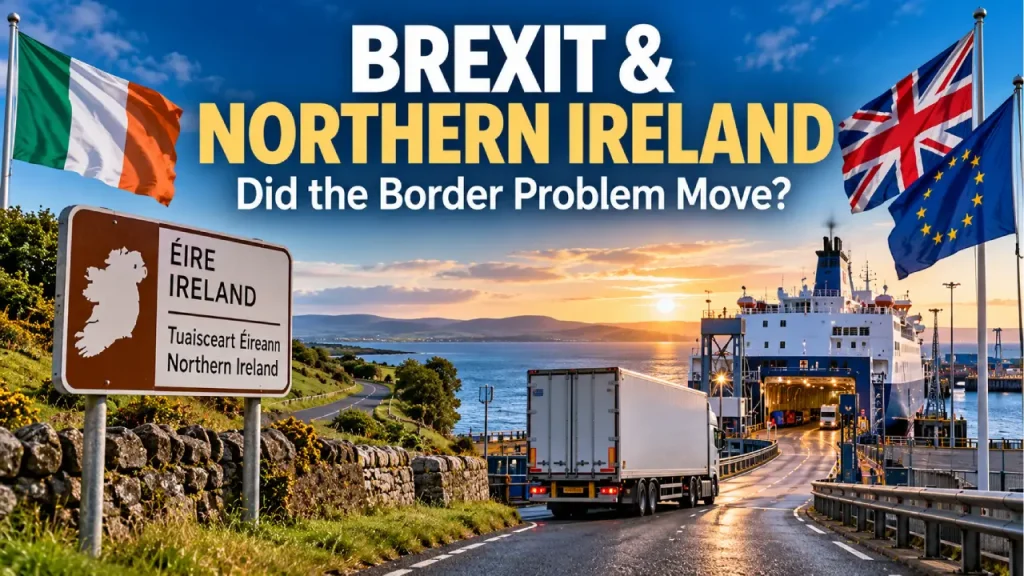
Brexit and Northern Ireland created one of the hardest practical questions of the UK’s departure from the European Union.
The UK wanted to leave the European Union’s single market and customs union. At the same time, successive governments promised there would be no hard border between Northern Ireland and the Republic of Ireland — and no new border within the United Kingdom.
Those objectives proved extremely difficult to reconcile.
The eventual solution kept the land border on the island of Ireland open, but introduced special trading arrangements for Northern Ireland and new controls on some goods moving from Great Britain to Northern Ireland.
So did Brexit solve the border problem?
The evidence suggests a more complicated answer: the hard land border was avoided, but many of the practical consequences of leaving the EU’s trading system were shifted elsewhere.
Why Brexit and Northern Ireland Created a Unique Problem
Northern Ireland is the only part of the United Kingdom that shares a land border with an EU member state.
That border is approximately 310 miles long, with numerous crossing points used every day by people travelling for work, education, shopping, farming, family life and business.
Before Brexit, both the UK and Ireland were members of the EU single market and customs union. Goods could cross the border without customs declarations, tariffs or routine regulatory checks.
The 1998 Belfast/Good Friday Agreement did not create the open border by itself, but the disappearance of customs posts and security infrastructure became an important part of everyday life after the peace process.
The UK and EU therefore agreed during the Brexit negotiations that a hard border — including physical infrastructure and related checks and controls — should be avoided.
The Common Travel Area between the UK and Ireland also remained in place, allowing British and Irish citizens to move freely between the two countries. That meant the central Brexit border problem was primarily about goods, customs and regulation, rather than passports.
What Was Promised?
During and after the 2016 referendum, politicians repeatedly said that Brexit should not result in a hard border on the island of Ireland.
In 2017, Prime Minister Theresa May went further.
Her government committed itself to three objectives:
- No hard border between Northern Ireland and Ireland
- No new borders within the United Kingdom
- The whole United Kingdom leaving the EU single market and customs union
Each objective was politically understandable.
Together, however, they created a serious practical problem.
Once two territories operate different customs and regulatory systems, authorities normally need some way of checking which rules apply to goods crossing between them.
If checks were not to take place at the Irish land border, and the UK as a whole was leaving the EU trading system, they had to find another arrangement.
That fundamental trade-off shaped years of Brexit negotiations.
The Northern Ireland Protocol
Boris Johnson’s government eventually negotiated the Northern Ireland Protocol as part of the UK-EU Withdrawal Agreement in 2019.
The Protocol avoided customs infrastructure on the land border between Northern Ireland and the Republic of Ireland.
To make that possible, Northern Ireland continued to follow a range of EU rules governing goods, while remaining legally part of the United Kingdom’s customs territory.
In practice, this meant that some goods entering Northern Ireland from Great Britain became subject to customs procedures, certification and regulatory checks.
The physical land border on the island of Ireland remained open.
But a new regulatory boundary had appeared for trade moving across the Irish Sea.
That was the central compromise.
Why the Protocol Became So Controversial
For many businesses, the Protocol introduced paperwork and new procedures that had not existed when the entire UK was inside the EU single market and customs union.
For Unionists, however, the objections went beyond paperwork.
They argued that applying some EU rules in Northern Ireland, together with checks on goods arriving from Great Britain, weakened Northern Ireland’s economic and constitutional place within the United Kingdom.
Supporters of the arrangements argued that some form of special treatment was unavoidable if Brexit was to proceed while preventing a hard Irish land border. They also pointed to Northern Ireland’s unusual ability to sell goods into both the UK internal market and the EU single market.
The dispute became severe enough to affect Northern Ireland’s devolved government.
In February 2022, the Democratic Unionist Party withdrew from the power-sharing institutions in protest over the Protocol. The Northern Ireland Assembly and Executive were not fully restored until February 2024.
The Windsor Framework
After lengthy negotiations, the UK and EU announced the Windsor Framework in February 2023.
It amended the Protocol’s operation rather than abolishing Northern Ireland’s special arrangements.
The changes included simplified procedures for many goods moving from Great Britain into Northern Ireland when they were intended to remain there.
Goods considered at risk of entering the EU single market continued to face fuller EU customs requirements.
The Framework also introduced easements for supermarket food, parcels and some other movements, while creating new mechanisms intended to give Northern Ireland politicians more influence over EU rules applying there.
One of those mechanisms is the Stormont Brake, which allows members of the Northern Ireland Assembly, under specified conditions, to object to certain amended or replacement EU rules. The final decision on whether the rule should be disapplied rests with the UK Government under the procedures agreed with the EU.
The Windsor Framework therefore reduced some of the friction created by the original Protocol.
It did not remove the underlying reason for those arrangements.
Northern Ireland still occupies a unique position because it is part of the UK while applying certain EU rules necessary to keep the Irish land border open.
Did the Irish Land Border Return?
No.
There are no routine customs posts or goods checkpoints along the Northern Ireland-Ireland border comparable to a normal external customs frontier.
That is a significant achievement of the Withdrawal Agreement, the Protocol, and the Windsor Framework.
It also matters politically and socially.
The open border is woven into everyday life across the island and is closely connected with the stability created since the Belfast/Good Friday Agreement.
But the land border remaining open does not mean Brexit removed the need for border administration.
Instead, much of that administration was redesigned around goods entering Northern Ireland from Great Britain, backed by data sharing, certification, labelling and risk-based controls.
Did Brexit Create an “Irish Sea Border”?
The phrase is politically charged, but it describes a real change.
Before Brexit, goods travelling from England, Scotland or Wales to Northern Ireland generally moved within the same EU regulatory and customs territory.
After Brexit, some of those movements became subject to procedures because Northern Ireland retained access to the EU goods market and continued applying relevant EU rules.
The Windsor Framework substantially reduced the burden for many goods staying in Northern Ireland, but it did not eliminate all regulatory differences.
So it would be misleading to say there is now a conventional international border in the Irish Sea.
It would be equally misleading to claim that Brexit left internal UK trade entirely unchanged.
What Did Northern Ireland’s Assembly Decide?
The Windsor Framework includes a democratic consent mechanism allowing the Northern Ireland Assembly to vote periodically on whether key parts of the arrangements should continue.
The first vote took place on 10 December 2024.
MLAs voted 48 to 36 in favour of continuing Articles 5 to 10 of the Framework.
However, the vote did not receive cross-community support.
All Unionist-designated MLAs who voted opposed the motion, while Nationalist-designated and Other-designated MLAs voted in favour.
Because the motion passed without cross-community support, UK law required the Government to commission an independent review.
Lord Murphy of Torfaen conducted that review in 2025. His report recommended changes to improve democratic scrutiny, communication, and support for businesses.
The UK Government accepted all of his recommendations in December 2025.
The next democratic consent vote is due in 2028.
This matters because it shows the arrangements have democratic support from a majority of MLAs, but remain politically contested across Northern Ireland’s communities.
Both facts matter.
Could Future UK-EU Cooperation Reduce the Friction Further?
Possibly.
At the UK-EU summit in May 2025, the two sides agreed to work towards a new sanitary and phytosanitary agreement covering food, animals and plants.
Such an agreement could reduce many of the regulatory checks required on agri-food trade between Great Britain and the EU and, as a consequence, could also simplify some movements into Northern Ireland.
As of September 2026, UK and EU officials were still working on how the future SPS agreement would interact with the Windsor Framework.
The UK Government has said it wants legislation implementing the agreement in place by 2027.
If successful, closer UK-EU regulatory cooperation could reduce some of the very barriers that Brexit created.
That would not abolish the Windsor Framework, but it could make parts of it considerably less intrusive for businesses and consumers.
For the wider picture, see Brexit: What Was Promised, What Happened, and What Comes Next.
The Brexit Files Verdict
Did Brexit solve Northern Ireland’s border problem?
Not in the sense of making the problem disappear.
Leaving the EU single market and customs union created a new customs and regulatory boundary that had not previously existed between the UK and Ireland.
The political task was therefore to decide where and how that boundary would operate.
The UK avoided a hard border on the island of Ireland.
The price was a special trading regime for Northern Ireland, with some checks and procedures applying to goods moving from Great Britain.
The original Northern Ireland Protocol made those arrangements highly contentious and, in some areas, cumbersome.
The Windsor Framework reduced many of the practical burdens and introduced additional democratic safeguards, but it did not eliminate Northern Ireland’s distinctive regulatory position.
So the fairest conclusion is:
Brexit did not remove the border problem. It changed its location and form.
That outcome was not simply imposed by one side. It emerged from the attempt to reconcile three competing objectives: leaving the EU trading system, protecting an open Irish border, and preserving frictionless trade within the United Kingdom.
No solution could fully deliver all three once the UK chose regulatory and customs separation from the EU.
That is one of the clearest lessons of the Northern Ireland Brexit story: political slogans can promise simplicity, but geography and trade rules still have to be dealt with.
Recommended Further Reading
- Brexit and Business: Did Leaving the EU Cut Red Tape — or Create More of It?
- Brexit: What Was Promised, What Happened, and What Comes Next
- Brexit Sovereignty: Did Britain Really Take Back Control of Its Laws?
- Brexit and Trade: Did “Global Britain” Deliver?
Sources
- House of Commons Library — The Northern Ireland Protocol and Windsor Framework
- Northern Ireland Assembly — The Windsor Framework
- Northern Ireland Assembly — Democratic Consent Mechanism
- Northern Ireland Assembly — Democratic Consent Resolution, 10 December 2024
- UK Government — Joint Report on Phase 1 of the Article 50 Negotiations
- UK Government — Windsor Framework
- UK Government — Safeguarding the Union
- UK Government — Independent Review of the Windsor Framework
- UK Government — Response to the Independent Review of the Windsor Framework
- UK Government — Windsor Framework Specialised Committee, 15 September 2026