Last reviewed: 6 October 2026
The debate over Brexit promises vs reality can now be judged against a decade of evidence.
On 23 June 2016, the United Kingdom made one of the most consequential political decisions in its modern history.
The result was close but clear: 17,410,742 people voted to leave the European Union, and 16,141,241 voted to remain — 51.9% to 48.1%, on a turnout of 72.2%.
That result deserves serious attention. So do the reasons millions of people voted Leave.
But respecting a democratic decision does not mean suspending judgement forever. Democracy also means being able to examine what was promised, compare it with what happened, learn from the evidence and decide what should come next.
Ten years after the referendum, Britain has enough experience of Brexit to begin doing exactly that.
This article does not argue that every Leave voter was misled, that every promise was false, or that the European Union is without faults. Nor were all claims made by the Remain campaign beyond criticism.
Instead, it asks a simpler question:
How do the main arguments used to sell Brexit compare with the Britain that actually emerged?
That is the starting point for any serious discussion about the UK’s future relationship with Europe.
What Did the 2016 Referendum Actually Decide?
The referendum asked one binary question:
Should the United Kingdom remain a member of the European Union or leave the European Union?
It did not ask voters to choose between different versions of Brexit.
There was no separate vote on whether the UK should remain in the Single Market, stay in the Customs Union, retain freedom of movement, follow a Norway-style arrangement, adopt a looser free-trade agreement, or leave without a deal.
Those decisions came later.
That matters because “Brexit” was never a single policy. It was an instruction to leave the EU, followed by a series of political choices about what kind of relationship should replace membership.
The eventual settlement took the UK outside both the EU Single Market and the Customs Union, creating a much more distant economic relationship than some other non-EU European countries have with the Union.
The distinction between the referendum result and the particular form of Brexit subsequently chosen is essential if Britain is to have an honest conversation about what happened next.
Official Electoral Commission referendum result
Promise One: “We Send the EU £350 Million a Week — Let’s Fund Our NHS Instead”
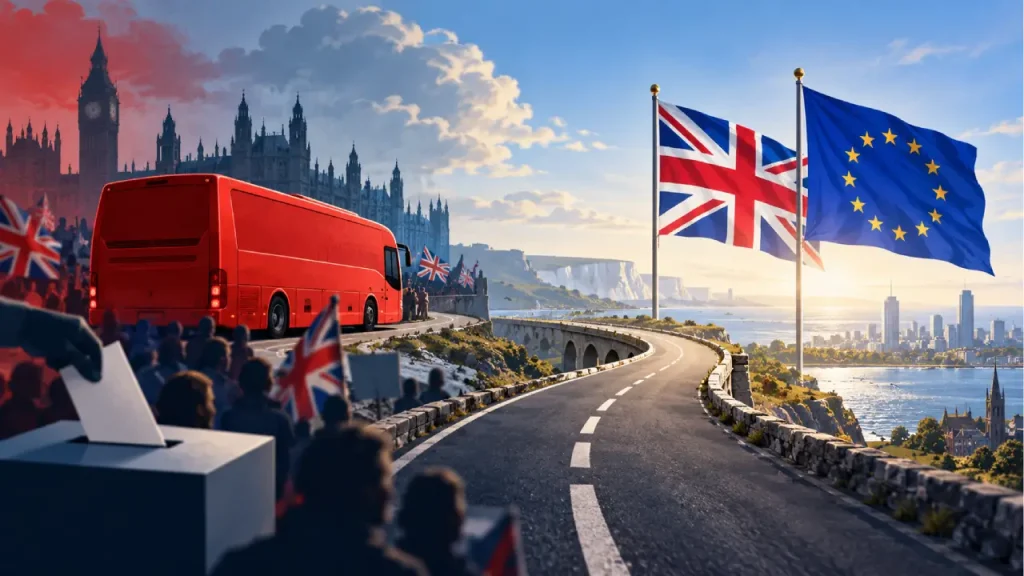
Few images from the referendum are better remembered than the red Vote Leave bus carrying the claim that Britain sent the EU £350 million a week, followed by the suggestion that the money could instead be spent on the NHS.
The problem was that the UK didn’t actually send £ 350 million to the EU.
The figure ignored the UK’s rebate — a discount applied before payment. Full Fact calculated during the campaign that the amount actually paid in 2015 was around £250 million per week, before taking account of money flowing back to the UK through EU programmes and other funding.
The UK’s net contribution was lower again.
The UK Statistics Authority subsequently described use of the £350 million figure in this context as a “clear misuse of official statistics.”
This does not mean NHS spending failed to rise after Brexit. It did rise substantially. But that is a different claim.
There was never a £350 million-a-week pot of money sitting in Brussels that could simply be brought home and handed to the NHS. Government spending depends on taxation, borrowing, economic growth and competing priorities — and any assessment of a “Brexit dividend” must also consider Brexit’s wider effect on the economy and public finances.
The distinction is important.
The NHS could receive more money after Brexit. But the £350 million claim did not accurately describe the money Britain was sending to the EU.
Full Fact: the £350 million claim
Promise Two: Britain Would Take Back Control
“Take Back Control” was probably the Leave campaign’s most powerful slogan because it spoke to something larger than any individual policy.
It meant control over laws, borders, trade and national decision-making.
In one important sense, Brexit did deliver greater formal autonomy.
The UK can now design its own immigration system, negotiate trade agreements independently, change regulations inherited from EU membership, and legislate in areas previously governed partly through EU institutions.
That is real.
But sovereignty is not the same thing as freedom from consequences or interdependence.
A British company exporting goods into the EU still has to satisfy EU rules if it wants access to the EU market. A UK government may choose different standards, but divergence can create additional costs for businesses trading across the Channel.
The same trade-off appears repeatedly in the post-Brexit relationship:
The further Britain moves away from common European rules, the more freedom it has to regulate differently — but the more friction it can create when trading with its largest neighbouring market.
That is not an argument that Britain must always follow EU rules. It is an argument for being clear about the choice.
The sovereignty gained through Brexit is therefore genuine, but it has never meant the ability to make decisions without economic or diplomatic consequences.
Promise Three: Britain Could Trade Freely With Europe and the Rest of the World
Brexit supporters argued that leaving the EU would allow Britain to pursue an independent global trade policy.
That part is true.
The UK has negotiated new agreements of its own, including deals with Australia, New Zealand and India, and it has joined the Comprehensive and Progressive Agreement for Trans-Pacific Partnership.
Many other post-Brexit agreements, however, replaced or rolled over agreements Britain already benefited from as an EU member.
Meanwhile, Europe has remained by far one of Britain’s most important markets.
According to the House of Commons Library, in 2025 the EU accounted for 41% of UK exports and 50% of UK imports. UK exports of goods and services to the EU were worth £384 billion, while imports from the EU were worth £472 billion.
Trade did not stop after Brexit. Nor was it expected to.
But the terms changed.
The EU-UK Trade and Cooperation Agreement provides tariff-free and quota-free trade for qualifying goods, but businesses now face customs procedures, rules-of-origin requirements and other regulatory barriers that did not exist when the UK was inside the Single Market and Customs Union.
The Office for Budget Responsibility continues to assume that, in the long run, Brexit will leave UK imports and exports around 15% lower than they would otherwise have been, with the associated reduction in trade intensity lowering potential productivity by around 4% relative to remaining in the EU.
That figure is an estimate of a counterfactual — what the economy might have looked like without Brexit — not a claim that the economy is literally 4% smaller than it was before the referendum.
That distinction matters.
Independent researchers have produced different estimates, but the broad conclusion across much of the economic literature is similar: higher barriers to Britain’s largest nearby market have imposed a continuing economic cost.
A 2026 Resolution Foundation study also found that the UK experienced the largest fall in goods exports among G7 countries after 2019. It estimated that UK goods exports would have been around £74 billion higher in 2024 had Britain simply maintained its 2019 share of global goods exports, while cautioning that Brexit was not the only force affecting trade.
Brexit gave Britain its own trade policy.
The harder question is whether the gains from that independence have outweighed the additional barriers placed between Britain and its largest trading partner.
House of Commons Library: UK-EU trade statistics
Office for Budget Responsibility: Brexit trade assumptions
Resolution Foundation: Leaving EU Behind
Promise Four: Brexit Would Give Britain Control of Immigration
Brexit did end EU freedom of movement.
That was a concrete change, and one of the clearest objectives of many Leave voters.
EU citizens who did not already have protected residence rights became subject to the UK’s immigration system, while British citizens lost their automatic free-movement rights across the EU.
The UK government therefore gained substantially greater control over who could migrate from EU countries and under what conditions.
But “control” and “lower immigration” are not the same thing.
After Brexit, governments chose to operate an immigration system that was more restrictive for many EU citizens while opening or expanding routes for workers, students and others from outside the EU.
The result was a major change in the composition of migration.
According to the Office for National Statistics, UK net migration later rose to a peak of around 944,000 in the year ending March 2023, driven largely by migration from outside the EU.
It then fell sharply.
For the year ending December 2025, provisional ONS estimates put net migration at 171,000, with non-EU migration still making the largest positive contribution while net migration of EU+ nationals was negative.
The lesson is straightforward:
Brexit gave UK governments more control over migration policy. It did not guarantee a particular migration number.
The eventual level of migration depends on the choices governments make — about work visas, universities, social care, health staffing, family migration, humanitarian schemes and the needs of the economy.
Political debate often loses that distinction.
Office for National Statistics: long-term international migration, year ending December 2025
Promise Five: Brexit Would Reduce EU Red Tape
One argument for leaving the EU was that Britain would be able to escape unwanted European regulation.
Again, this is a real change.
Parliament can now amend or repeal laws inherited from EU membership in areas where international agreements and other legal commitments allow it.
But Brexit also created an entirely new layer of bureaucracy for businesses moving goods between Great Britain and the EU.
Customs declarations, product requirements, rules of origin, sanitary and phytosanitary controls and other border procedures became part of ordinary UK-EU trade.
The Trade and Cooperation Agreement removed many tariffs, but it did not recreate the frictionless trading environment of the Single Market and Customs Union.
So both statements can be true at once:
- Britain gained more freedom to change domestic regulation.
- Businesses trading with Europe acquired additional border and compliance requirements.
Whether Brexit produced “less red tape” therefore depends very heavily on which business, which sector and which regulation is being discussed.
For a company that trades almost entirely within the UK, regulatory freedom may matter more.
For a small exporter moving food, manufactured goods or components repeatedly across the Channel, the additional border friction can matter far more.
House of Commons Library: customs rules for trade with the EU
The Problem Brexit Could Not Wish Away: Northern Ireland
Northern Ireland exposed one of Brexit’s hardest practical contradictions.
The UK wanted to leave the EU Single Market and Customs Union.
At the same time, all sides wanted to avoid the return of a hard land border between Northern Ireland and the Republic of Ireland — an issue with profound economic, political and security implications.
No perfect way existed to satisfy both objectives once the UK and EU operated under different customs and regulatory systems.
The eventual Northern Ireland Protocol, later modified by the Windsor Framework, created special arrangements for Northern Ireland so that goods could continue to move across the Irish land border without routine physical checks.
Those arrangements reduced one problem while creating others, particularly for some goods moving between Great Britain and Northern Ireland.
The years of argument that followed were not an accidental side issue.
They illustrated something fundamental about Brexit: geography still matters.
Britain can change its treaties. It cannot change the fact that it shares a land border, supply chains, security interests, seas, energy systems and a continent with the European Union.
House of Commons Library: the Northern Ireland Protocol and Windsor Framework
What Changed for Ordinary British Citizens?
Brexit was not only about trade statistics and constitutional theory.
It changed individual rights.
Before Brexit, British citizens were also EU citizens. They could move to another EU member state to live, work or study under European free-movement rules.
Those automatic rights ended when the Brexit transition period finished on 31 December 2020.
For most short visits to the Schengen area, British citizens can still travel without obtaining a visa in advance, but stays are generally limited to 90 days in any 180-day period.
Living, working or studying in an EU country now normally depends on that country’s immigration and visa rules.
People who were already lawfully resident in an EU country before the end of the transition period may have rights protected under the Withdrawal Agreement, but those protections do not recreate full EU free movement throughout the Union.
This was one of the clearest practical exchanges created by Brexit:
Britain gained the ability to end free movement into the UK, while British citizens lost free movement across the EU.
House of Commons Library: visiting, working and living in the EU after Brexit
So Did Brexit Achieve Anything?
Yes.
Any serious assessment should acknowledge that.
Brexit gave the UK:
- an independent trade policy;
- the power to operate its own immigration system for EU as well as non-EU nationals;
- greater freedom to diverge from EU regulation;
- freedom from direct participation in EU political institutions;
- greater formal national control in areas previously governed jointly through EU structures.
For voters who valued national autonomy more than economic integration, those changes may themselves represent success.
But public policy cannot be assessed only by asking whether powers were transferred.
It must also ask what those powers have achieved, what trade-offs accompanied them and whether the country is better equipped to deal with the challenges it faces.
That is where the Brexit debate now needs to mature.
The choice was never simply between control and no control.
It was between different ways of exercising sovereignty in an interconnected world.
Britain and the EU Are Already Moving Closer Again
Whatever language politicians use, the post-Brexit relationship has already begun evolving.
The UK and EU have been negotiating ways to reduce some of the barriers created after Brexit and expand cooperation in areas of common interest.
The UK is due to participate again in Erasmus+ from 2027, reopening opportunities for students, apprentices, young people and educational organisations.
The UK government and EU have also been working towards a new sanitary and phytosanitary agreement intended to reduce many barriers affecting food, agricultural products, plants and animals. The UK government has said it intends the new arrangements to take effect in mid-2027, subject to negotiations.
Work has also continued on youth mobility, energy cooperation, emissions trading, security and defence.
These measures do not amount to rejoining the European Union.
But they show something important: even after Brexit, Britain and the EU repeatedly look for ways to rebuild cooperation.
UK Government: UK to participate in Erasmus+ from 2027
UK Government: preparing for a UK-EU SPS agreement
The Debate Has Changed Again
At the time of writing in October 2026, Britain’s political conversation about Europe is changing once more.
The question is no longer simply whether Brexit should have happened.
Increasingly, it is:
What relationship with Europe now best serves Britain’s future?
That could mean a closer trade agreement.
It could mean deeper participation in European programmes.
It could eventually mean debating participation in the Single Market, a Customs Union or some other form of structured economic relationship.
And, if public opinion and political circumstances move far enough, it could ultimately mean considering EU membership again.
No serious route back would be quick, automatic or guaranteed.
But neither is Brexit constitutionally irreversible.
Could Britain Rejoin the European Union?
Yes — legally, Britain could apply to rejoin the EU.
It would do so under Article 49 of the Treaty on European Union, the same accession process that applies to other European countries seeking membership.
An application would need the agreement of all EU member states to progress. Negotiations would examine Britain’s ability to meet the obligations of membership, and any eventual accession treaty would need approval and ratification through the required EU and national procedures.
Britain could not simply press a “reset” button and restore its previous membership on exactly the old terms.
Any future membership would have to be negotiated.
That means a credible campaign to rejoin must not pretend there is an easy shortcut.
It would require:
- a durable democratic mandate in the UK;
- a government willing to make membership an explicit objective;
- constructive relations with EU governments and institutions;
- negotiations over the terms of accession;
- public consent to the eventual settlement.
That is a serious political project — but it is entirely different from saying that rejoining is impossible.
European Union: how countries join the EU
A Realistic Route Forward
Britain does not need to choose between pretending Brexit has been a success in every respect and trying to reverse 2016.
There is a more sensible path.
1. Tell the truth about what happened
The country needs an honest, evidence-led assessment of Brexit’s economic, social and political effects.
That includes acknowledging genuine gains in national decision-making as well as genuine costs.
2. Rebuild practical cooperation
Where closer UK-EU cooperation makes Britain safer, more prosperous or more competitive, ideology should not stand in the way.
Food trade, research, education, energy, defence, crime, investment and youth mobility are obvious places to start.
3. Reduce unnecessary barriers
Britain should examine where regulatory alignment or mutual recognition produces greater benefits than divergence.
Sovereignty includes the freedom to cooperate.
Choosing common rules because they are useful is not the same as having no choice.
4. Rebuild trust with Europe
Any future British government hoping for a much closer relationship — let alone renewed membership — will need credibility with the EU’s institutions and member states.
That will take consistency and time.
5. Let democracy decide what comes next
The 2016 referendum was an exercise in democracy.
So would be a future decision to change course.
A democratic vote does not bind a country to one policy for eternity. Governments change. Treaties change. Circumstances change. Voters change their minds.
If Britain eventually develops a sustained democratic majority for rejoining the European Union, the proper response would be to make the case openly, negotiate honestly and allow the public to decide.
Brexit Promises vs Reality: The Brexit Files
“£350 million a week for the NHS”
What happened: The headline figure did not reflect the UK’s actual payment after the rebate and ignored EU spending returning to the UK. NHS spending later rose, but there was no simple £350 million-a-week Brexit dividend.
“Take back control”
What happened: Britain regained important legal and policy powers, but exercising those powers involves trade-offs, particularly when UK rules diverge from those of its largest neighbouring market.
“A global trading Britain”
What happened: The UK gained an independent trade policy and signed new agreements, but the EU remains a huge share of British trade and new barriers have made UK-EU goods trade more complicated.
“Control immigration”
What happened: Free movement ended and the UK gained greater control over EU migration. Overall migration later rose sharply because of policy choices and non-EU migration before falling substantially again.
“Cut EU red tape”
What happened: Britain gained more freedom over domestic regulation, while businesses trading with Europe acquired new customs and compliance requirements.
Undoing Brexit Does Not Mean Erasing History
Britain voted to leave the European Union in 2016.
That happened.
It cannot — and should not — be edited out of the country’s history.
But respecting that vote does not require pretending that every claim made during the campaign proved correct or that every consequence must be accepted forever.
The purpose of looking back is not to punish people for the way they voted.
It is to learn.
Millions of people voted Leave because they wanted a country that was more democratic, more prosperous, better governed and more responsive to their concerns.
Those ambitions deserve respect.
The question now is whether the Brexit settlement Britain chose has delivered them — and, where it has not, whether a closer relationship with Europe could do better.
That is the argument Britain should be having.
Not Leave versus Remain forever.
But what works now, what kind of country we want to become, and what relationship with our European neighbours gives Britain the best chance of achieving it.
That is where the conversation about undoing Brexit should begin.
Recommended Further Reading
Sources and Further Reading
- Electoral Commission — 2016 EU referendum report
- Full Fact — £350 million EU claim
- House of Commons Library — Statistics on UK-EU trade
- Office for Budget Responsibility — Economic and fiscal outlook, March 2024
- Resolution Foundation — Leaving EU Behind
- Office for National Statistics — Long-term international migration
- House of Commons Library — Customs rules for trade with the EU
- House of Commons Library — Northern Ireland Protocol and Windsor Framework
- House of Commons Library — Visiting, working and living in the EU after Brexit
- UK Government — Erasmus+ from 2027
- UK Government — UK-EU SPS agreement preparation
- European Union — EU enlargement and accession