Last reviewed: 7 October 2026
THE BREXIT FILES — Claim. Evidence. Outcome.
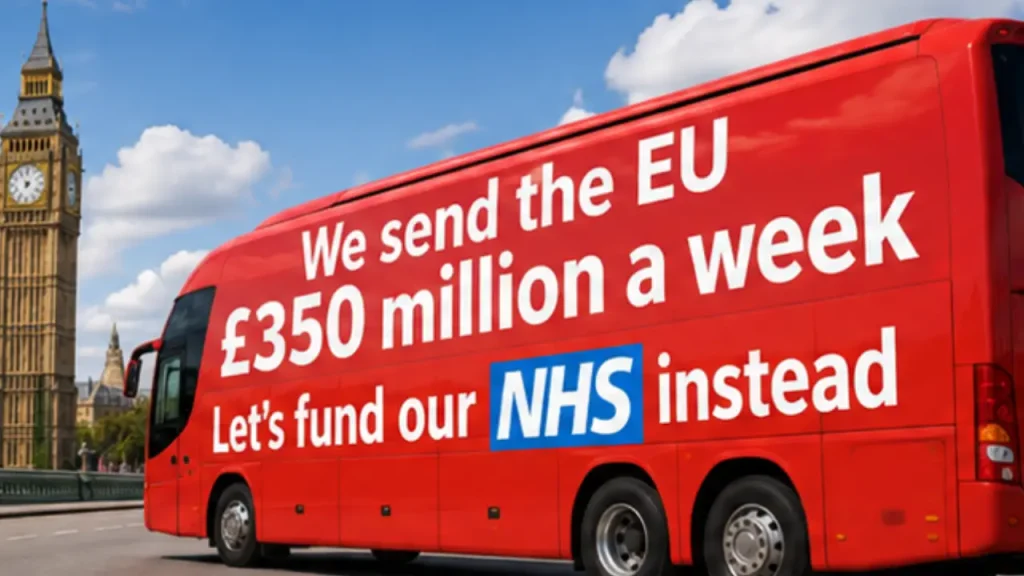
The £350 million NHS claim became one of the defining images of the 2016 EU referendum campaign, emblazoned across Vote Leave’s red campaign bus.
“We send the EU £350 million a week. Let’s fund our NHS instead.”
Ten years later, the argument over that sentence still hasn’t gone away.
Some people remember it as a broken promise. Others argue that the NHS ultimately received even more than £350 million a week in additional funding, so the claim was vindicated.
Both versions oversimplify what actually happened.
The real question is not whether NHS spending eventually increased. It did.
The question is whether the United Kingdom was really sending £350 million a week to the European Union, whether that entire amount would become available after Brexit, and whether later NHS spending increases can fairly be described as the promised “Brexit dividend”.
The evidence gives us a much clearer answer.
What Exactly Did Vote Leave Say?
The most famous wording appeared on the side of the Vote Leave bus:
“We send the EU £350 million a week. Let’s fund our NHS instead.”
It was not an obscure statistic buried in a policy paper. The £350 million figure became a central message of the Leave campaign.
Vote Leave also argued that money no longer paid to the EU could instead be spent on domestic priorities such as the NHS and schools.
However, it is important to distinguish between a campaign slogan and a government spending commitment.
Vote Leave was a referendum campaign, not the government. The bus did not say that an incoming government was legally committed to transfer exactly £350 million every week to the NHS.
But that does not make the wording unimportant.
The clear political message was that Britain was sending £350 million a week to Brussels and that leaving the EU would make that money available to spend at home, with the NHS presented as the most prominent alternative.
That is the claim we need to test.
Where Did the £350 Million Figure Come From?
The figure was based on a gross measure of the UK’s contribution to the EU budget before important adjustments were taken into account.
This is where the argument becomes confusing, because several different figures could legitimately be produced depending on what was being measured.
For example, HM Treasury’s 2015 EU finances report estimated the following for the 2015 calendar year:
- Gross payments before the UK rebate: about £17.8 billion
- Contribution after the rebate: about £12.9 billion
- Net contribution after public-sector receipts: about £8.5 billion
Expressed very roughly per week, those figures are around:
- £342 million a week before the rebate
- £248 million a week after the rebate
- £163 million a week after also deducting public-sector receipts from the EU
And there was another complication: some EU money was paid directly to private-sector organisations, universities and researchers and therefore did not appear in the public-sector receipts figure.
So there was never only one number that could be called “Britain’s contribution”.
The important question is what the campaign meant when it said “We send the EU £350 million a week.”
HM Treasury — European Union Finances 2015
The Rebate Changed the Picture
Britain had a long-standing rebate on its EU budget contribution.
Crucially, the rebate was not money that Britain first sent to Brussels and later received back.
It was deducted before the UK made its payment.
That distinction matters because if the rebate reduced the amount actually paid, the unreduced gross figure could not simply become available for other spending after Brexit.
During the referendum campaign, the UK Statistics Authority repeatedly objected to how the £350 million figure was presented.
In May 2016, its chair said that continuing to use the gross figure in a context that implied it was a net payment was misleading.
The Authority specifically pointed out that the contribution was paid after the rebate was applied, and that money also flowed back from the EU to the UK public and private sectors.
In other words, the problem was not that the gross figure had been invented from nothing.
The problem was the impression created by describing it as money Britain actually “sent” every week and could therefore recover in full.
UK Statistics Authority — Statement on UK contributions to the EU
Money Also Came Back to Britain
The rebate was only part of the story.
EU funds also returned to Britain through programmes supporting areas such as:
- agriculture;
- regional development;
- research;
- universities;
- science;
- rural development;
- social programmes.
HM Treasury estimated public-sector receipts from the EU at around £4.4 billion in 2015.
It also noted that some EU payments went directly to private-sector recipients, including research funding, and therefore were not included in that public-sector figure.
That does not mean EU membership was financially free.
Britain was a net contributor to the EU budget: it paid in more than it received back.
That is an important fact and should not be obscured.
But being a net contributor is very different from saying that the whole £350 million gross figure represented money available to be redirected elsewhere.
It did not.
What Did Parliament’s Treasury Committee Conclude?
The House of Commons Treasury Committee examined referendum campaign claims before the vote.
Its conclusion on the £350 million message was unusually direct.
The Committee said Vote Leave’s presentation was “highly misleading” and concluded that Brexit would not produce a £350 million-a-week fiscal windfall simply by ending contributions to the EU budget.
It highlighted two central problems.
First, the figure did not account for the UK rebate.
Second, it did not account for money received back from the EU.
The Committee also made a broader point that remains important today: the financial consequences of Brexit could not sensibly be judged only by looking at EU budget contributions.
If leaving the EU affected economic growth, investment, trade and tax revenues, those effects could ultimately matter much more to the public finances than the membership contribution itself.
It is also worth noting that the Treasury Committee did not reserve its criticism for Leave.
Its wider report challenged misleading or exaggerated claims made during the referendum debate on both sides.
That matters because examining the £350 million claim should not require pretending every statement made by the Remain campaign was beyond criticism.
House of Commons Treasury Committee — Economic and financial costs and benefits of EU membership
So What Was Britain’s Real Contribution?
There is no single useful number until you decide what you are trying to measure.
If you want the gross liability before the rebate, you get one figure.
If you want the amount after the rebate, you get another.
If you then subtract public-sector receipts, you get a lower net contribution.
If you also include EU payments made directly to organisations outside government, the number changes again.
That is precisely why the bus slogan was so powerful — and so problematic.
A complicated set of financial flows was reduced to one enormous number and one simple proposition:
£350 million leaves Britain every week; Brexit lets us spend it on the NHS instead.
The reality was substantially more complicated.
For 2015, HM Treasury estimated Britain’s net contribution after the rebate and public-sector receipts at about £8.5 billion for the year, or roughly £163 million per week.
That was still a substantial amount of money.
But it was nowhere near £350 million a week.
Was the Bus Claim a “Lie”?
This is where language matters.
Calling something a lie implies knowledge and intent — that someone knowingly said something false.
We do not need to establish motive to evaluate the claim.
The safer and more useful conclusion is the one supported by the statistical authorities and parliamentary scrutiny:
The £350 million figure was misleading as presented.
There was a gross accounting figure in that general region.
But Britain did not actually transfer the full £350 million every week after its rebate, and it could not simply reclaim the full amount and redirect it to the NHS.
That is strong enough.
There is no need to exaggerate the case.
But Didn’t the NHS Eventually Receive More Than £350 Million a Week?
Yes — and this is the part that is often left out of arguments about the bus.
In June 2018, Prime Minister Theresa May announced a long-term funding settlement under which the NHS England budget would be £20.5 billion a year higher in real terms by 2023/24 than at the starting point.
The government described that as an increase of approximately £394 million per week.
May explicitly linked some of the funding to money that would no longer be spent on EU membership after Brexit.
But she also said something equally important:
The commitment went beyond any Brexit dividend, and taxpayers would have to contribute more.
So it is perfectly accurate to say that a government later announced an NHS spending increase larger than £350 million a week.
What does not follow is that the original bus calculation was therefore correct.
UK Government — PM speech on the NHS, 18 June 2018
Did NHS Spending Actually Rise?
Yes.
NHS and health spending increased substantially in the years after the referendum and Brexit.
A 2026 Full Fact review concluded that, on reasonable measures comparing the post-Brexit/post-Covid period with the years before Brexit, the government was spending considerably more than an additional £350 million per week on the NHS in real terms.
But that comparison needs context.
NHS spending was already rising over time before Brexit.
An ageing population, medical advances, staffing costs and increasing demand all place sustained upward pressure on health spending.
Then came the Covid-19 pandemic, which produced extraordinary increases in public health expenditure.
So the fact that NHS spending later rose by more than £350 million per week does not tell us where that money came from.
Nor does it prove that Brexit generated an equivalent fiscal dividend.
Full Fact — The Brexit vote 10 years on
Was There Really a “Brexit Dividend”?
In the narrowest sense, leaving the European Union eventually meant the UK no longer made its normal member-state contribution to the EU budget.
That represented a saving compared with continuing to pay the contribution.
But governments do not operate their finances in isolated pots.
After Brexit, Britain also had domestic spending commitments that EU programmes had previously supported.
There were transition and withdrawal-related payments.
Most importantly, Brexit could also affect the wider economy — and therefore tax revenues.
The Institute for Fiscal Studies warned in 2018 that talking about a simple “Brexit dividend” was misleading because Brexit’s effect on government finances depended far more on its economic consequences than on the membership contribution alone.
A relatively modest reduction in economic growth and tax revenue could outweigh the direct budget saving.
That is why it is not enough to say:
“We stopped paying the EU, therefore that money funded the NHS.”
Public finances do not work that neatly.
Institute for Fiscal Studies — The Brexit dividend debunked
What Does the OBR Say About the Wider Economic Effect?
The Office for Budget Responsibility — the UK’s official independent fiscal forecaster — continues to build a significant long-term Brexit effect into its forecasts.
In its 2026 assessment, the OBR assumes the post-Brexit UK-EU trading relationship will leave long-run UK productivity around 4% lower than it would have been had the UK remained in the EU.
That is a counterfactual forecast assumption.
It does not mean Britain’s economy literally shrank by 4% after Brexit.
It means the OBR estimates that the economy will ultimately be about 4% less productive than the alternative path it believes Britain would have followed inside the EU.
That distinction is important.
But it also illustrates why the idea of a simple Brexit dividend is inadequate.
You can’t assess savings on one line of government spending without considering what Brexit does to the wider economy, tax receipts, and other spending commitments.
Office for Budget Responsibility — Brexit analysis
What the £350 Million Claim Got Right
A fair assessment should acknowledge the parts of the argument that were true.
Britain was a net contributor to the EU budget.
Leaving the EU meant that, after the transition and financial settlement arrangements, the UK would no longer continue making ordinary membership contributions in the same way.
That gave future governments some additional discretion over money that would otherwise have formed part of Britain’s contribution to the EU budget.
And the NHS did subsequently receive very large increases in funding.
Those facts matter.
But they do not rescue the wording of the bus claim.
What the £350 Million Claim Got Wrong
The campaign message blurred several very different things together.
It treated a gross figure as though it represented the money Britain actually paid.
It ignored the rebate, even though the rebate was deducted before payment.
It did not adequately reflect money flowing back to the UK through EU programmes.
And it implied that the whole £350 million could become available for domestic priorities after Brexit.
That final implication was the most important.
Britain could not stop sending money that it was never actually sending in the first place.
The Verdict
THE BREXIT FILES
Claim: Britain sent the EU £350 million every week and leaving would allow that money to be used to fund the NHS instead.
Evidence: The £350 million figure was a gross measure that did not properly reflect the UK rebate or EU receipts. HM Treasury estimated the UK’s 2015 contribution at about £248 million per week after the rebate and roughly £163 million per week after public-sector receipts.
Outcome: Britain left the EU and NHS spending later increased by more than £350 million per week. But the later increase does not make the original £350 million calculation accurate or demonstrate that it was financed by an equivalent Brexit dividend.
Verdict: Misleading as presented.
This is the distinction that matters.
The problem with the £350 million claim was not that Britain paid nothing to the European Union.
It did.
Britain was a net contributor.
Nor is it true that the NHS never subsequently received spending increases greater than £350 million a week.
It did.
The problem was presenting a pre-rebate gross figure in a way that suggested £350 million actually left Britain every week and would become available in full after Brexit.
It did not.
That conclusion does not require us to insult Leave voters, rewrite history or pretend every Remain campaign claim was accurate.
It simply requires us to follow the money.
And that is exactly what The Brexit Files should do.