What changed after Brexit? The UK’s departure from the European Union altered arrangements for trade, travel, citizens’ rights, Northern Ireland and many other areas.
Some changes began when the UK left the EU on 31 January 2020. Others took effect when the transition period ended on 31 December 2020 and the new UK–EU relationship began on 1 January 2021.
The effects have been felt across trade, travel, work, citizens’ rights, Northern Ireland, research, energy, fisheries and many other areas of everyday life.
What Changed After Brexit at a Glance
Four of the most significant practical changes are summarised below.
Trade & Goods
New customs procedures and rules of origin changed how goods move between Great Britain and the EU.
Travel & Movement
Free movement ended, changing the rules for travel, longer stays, work and study between the UK and EU.
Work & Citizens' Rights
Brexit changed the rules for working, studying and residence, while the Withdrawal Agreement protects many people who were already living across the UK–EU divide.
UK–EU Cooperation
The UK and EU continue to cooperate through agreements covering trade, research, energy, fisheries, Northern Ireland and other areas.
What Is Brexit?
Brexit is the commonly used term for the United Kingdom’s withdrawal from the European Union (EU). The word combines “Britain” and “exit”.
On 23 June 2016, the UK held a referendum in which a majority of those who voted supported leaving the European Union. After several years of negotiations, the UK formally left the EU on 31 January 2020.
A transition period then continued until 31 December 2020. During that period, most EU rules continued to apply in the UK. On 1 January 2021, the EU–UK Trade and Cooperation Agreement began applying provisionally, establishing the basis for the new relationship alongside the Withdrawal Agreement.
Sources: House of Commons Library — Brexit Timeline | European Commission — EU–UK Trade and Cooperation Agreement
How Did Brexit Come About?
The United Kingdom’s relationship with European integration began long before the Brexit referendum. On 1 January 1973, the UK joined the European Economic Community (EEC), commonly known as the Common Market.
Membership remained politically debated. In June 1975, the UK held its first nationwide referendum, asking voters whether the country should remain in the European Community. Of those who voted, 67.2% supported continued membership, while 32.8% voted to leave.
Over the following decades, European integration deepened. The Single European Act, which entered into force in 1987, aimed to complete the European single market.
The Maastricht Treaty, which entered into force on 1 November 1993, formally created the European Union and expanded cooperation into areas including foreign and security policy and justice and home affairs.
Sources: UK Parliament — The EEC and the Single European Act | European Union — History 1990–99
The Road to the 2016 Referendum
During 2015, the UK government sought changes to the terms of its EU membership. The negotiations focused on four main areas: economic governance, competitiveness, sovereignty, and social benefits and the free movement of people.
On 18–19 February 2016, EU leaders agreed a new settlement for the United Kingdom within the European Union. The arrangements were intended to take effect if the UK voted to remain.
On 20 February 2016, following a Cabinet meeting, David Cameron announced that the government would propose holding the referendum on Thursday 23 June 2016.
The settlement was conditional on continued UK membership. Following the referendum result, it did not take effect and ceased to exist.
Sources: House of Commons Library — European Union Referendum Bill 2015–16 | European Council — Negotiations Ahead of the UK's EU Referendum | UK Government — PM Statement, 20 February 2016
The 2016 Referendum Campaign
The referendum campaign brought together political parties, campaign organisations and individuals with sharply differing views on the United Kingdom’s membership of the European Union.
On 13 April 2016, the Electoral Commission designated two official lead campaigners: Vote Leave for the Leave outcome and Britain Stronger in Europe for Remain. Many other organisations and individuals also campaigned on both sides.
The Leave campaign focused heavily on sovereignty, immigration and free movement, the ability of the UK to make laws outside EU institutions, and the prospect of pursuing an independent trade policy.
The Remain campaign emphasised the economic benefits of EU membership, access to the European single market, international cooperation and the potential economic risks of leaving. Both sides made prominent claims about Britain’s future, some of which became the subject of considerable public debate.
Sources: Electoral Commission — Designation of the Lead Campaigners | House of Commons Library — EU Reform Negotiations and the Tusk Package
Examining the Campaign Claims
Campaign Claim
Vote Leave promoted the message that the UK sent £350 million a week to the EU and suggested that this money could instead be spent on the NHS.
What the Evidence Showed
The UK Statistics Authority said the £350 million figure did not account for the UK rebate or payments received from the EU, and that presenting the gross figure as money available to spend elsewhere was misleading.
The £350 million figure became one of the most prominent claims of the referendum campaign. The UK Statistics Authority challenged the way it was presented, because it did not reflect the UK rebate or relevant payments flowing back from the EU.
The Remain campaign also used economic projections to support its arguments. In April 2016, HM Treasury published an analysis estimating that, under a particular future trade arrangement, leaving the EU would reduce annual UK economic output by an amount equivalent to £4,300 per household after 15 years, compared with continued membership.
The figure was a modelled estimate of GDP per household, not a prediction that every household would lose £4,300 in disposable income. A House of Commons Treasury Committee report subsequently highlighted the importance of distinguishing these measures and explaining the uncertainties surrounding economic forecasts.
Sources: UK Statistics Authority — Statement on EU Contributions | HM Treasury — Long-term Economic Impact Analysis | House of Commons Treasury Committee — Economic and Financial Costs and Benefits of EU Membership
The Official 2016 Referendum Result
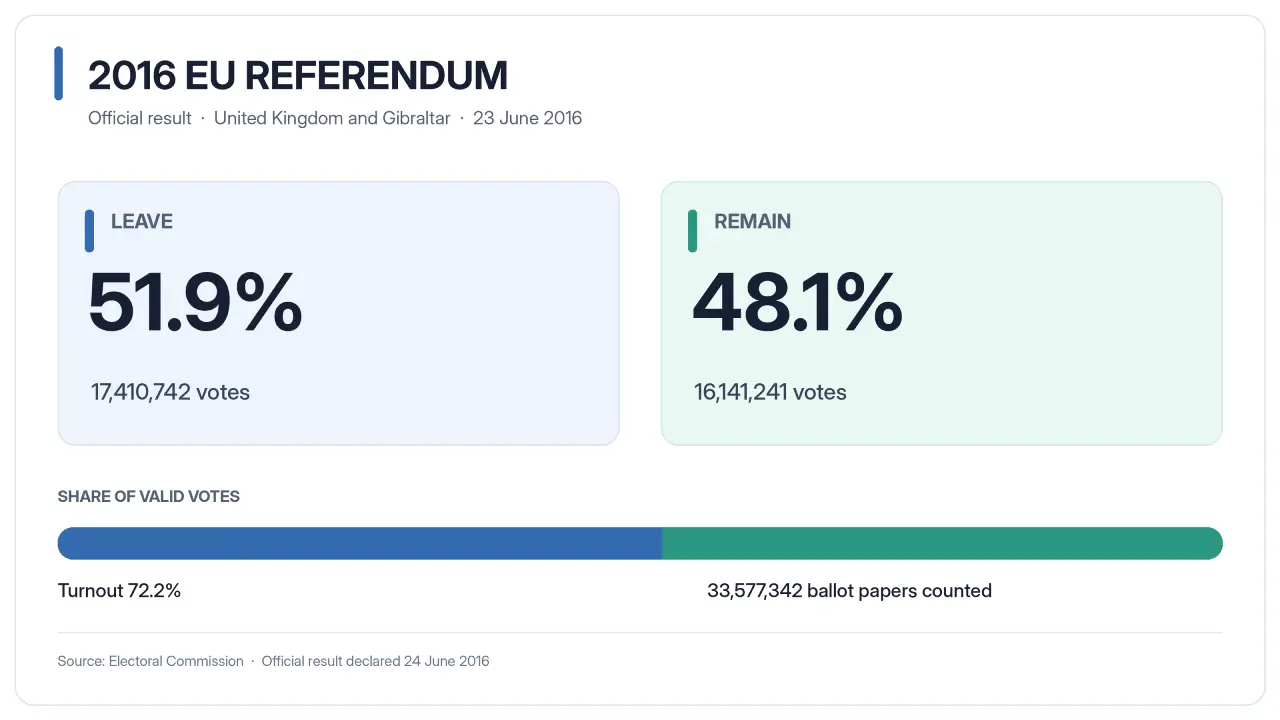
On 23 June 2016, voters across the United Kingdom and Gibraltar took part in the referendum on continued membership of the European Union. The official result was declared on 24 June 2016.
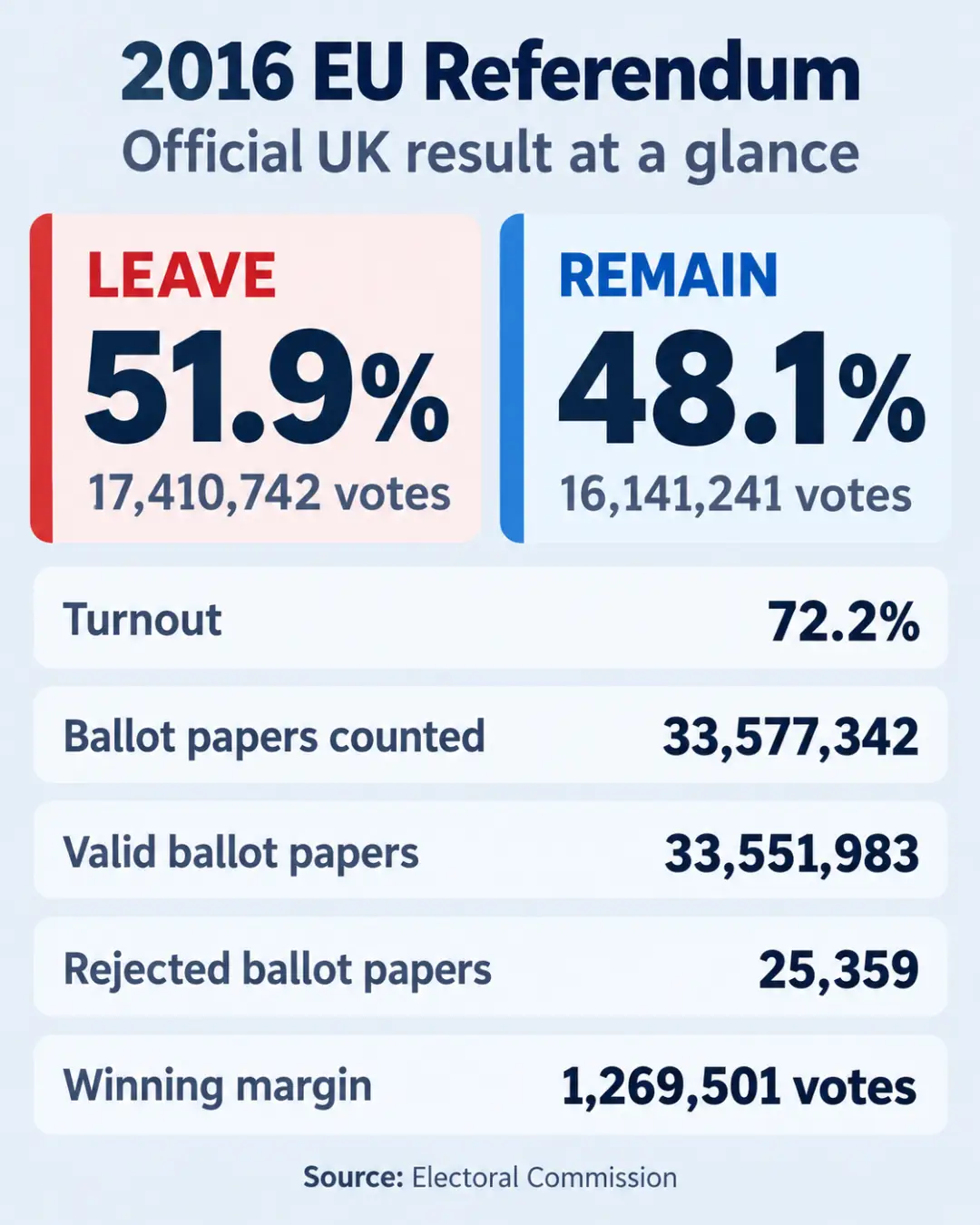
Leave received 17,410,742 valid votes (51.9%), while Remain received 16,141,241 (48.1%). Leave therefore won by 1,269,501 votes.
Turnout was 72.2%. A total of 33,577,342 ballot papers were counted, of which 33,551,983 were valid and 25,359 were rejected.
Source: Electoral Commission — Official Result of the 2016 EU Referendum
The result established a majority for leaving among those who cast valid votes. However, voting patterns differed considerably across the four nations of the United Kingdom.
Sources: House of Commons Library — Analysis of the EU Referendum Results 2016 | Electoral Commission — Report on the 23 June 2016 Referendum
How Did the Four Nations Vote?
Although the overall referendum produced a majority in favour of leaving the European Union, the results differed across the four nations of the United Kingdom.
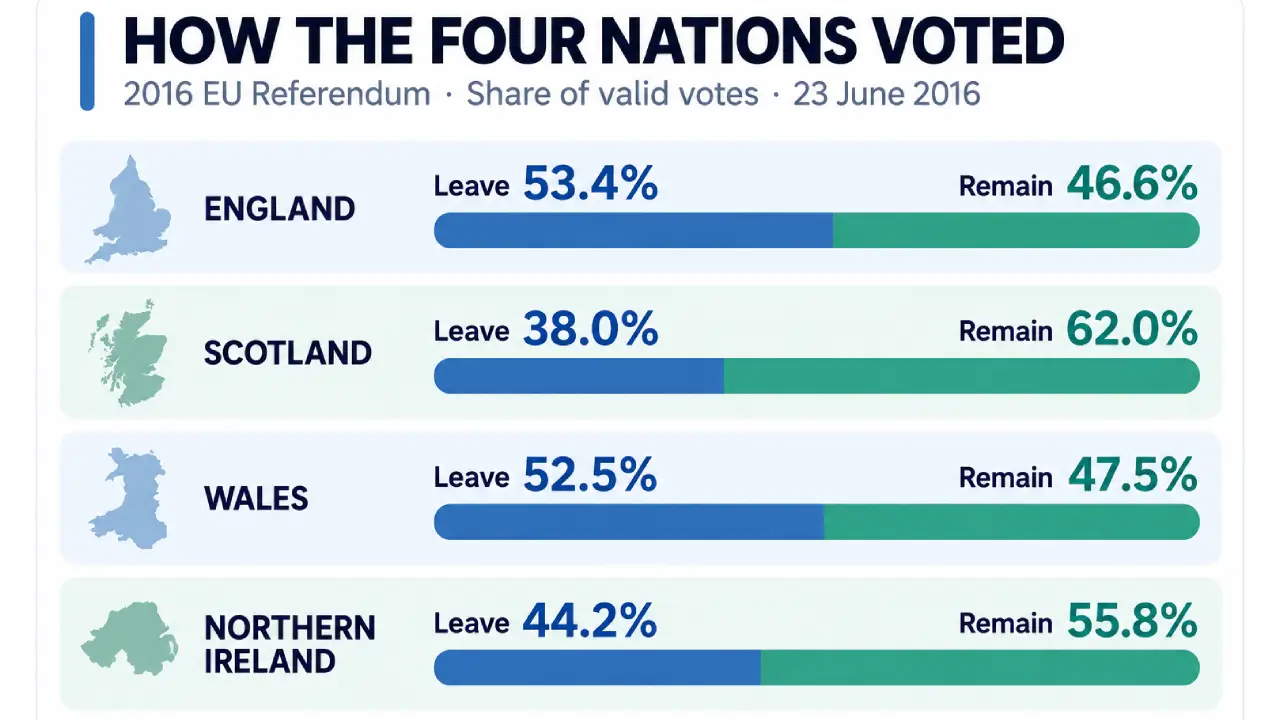
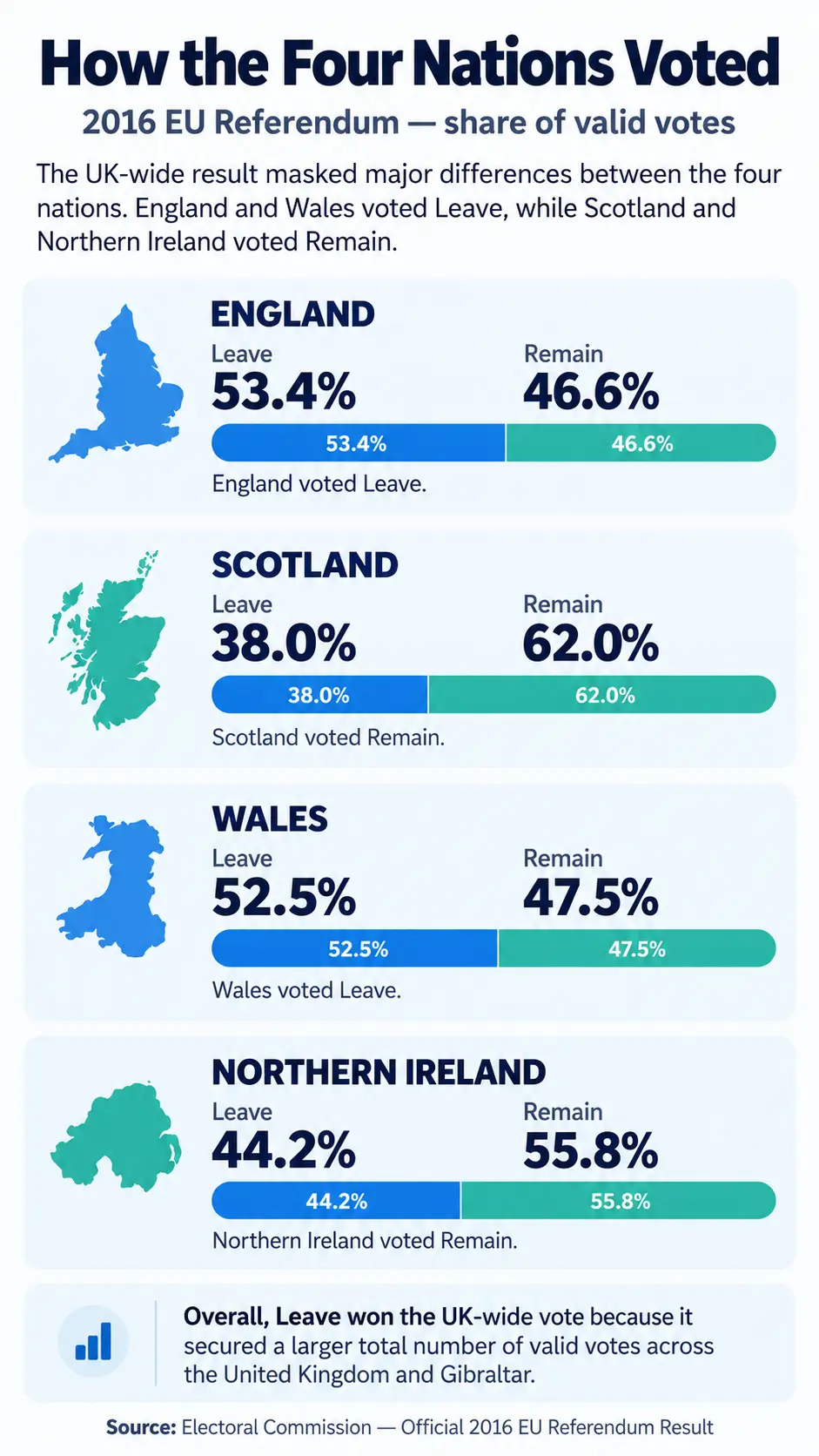
The national pattern was divided. Leave won a majority in England (53.4%) and Wales (52.5%), while Remain won in Scotland (62.0%) and Northern Ireland (55.8%).
The overall referendum result was determined by the total number of valid votes cast across the United Kingdom and Gibraltar. Separate majorities in each of the four nations were not required.
Voting patterns also varied considerably within England. London was the only English region to record a Remain majority. These geographical differences subsequently became an important part of political and constitutional debates surrounding Brexit.
Sources: House of Commons Library — Analysis of the EU Referendum Results 2016 | Electoral Commission — EU Referendum Results by Region
What Happened Immediately After the Referendum?
On 24 June 2016, following the referendum result, Prime Minister David Cameron announced that he would step down. Cameron had campaigned for the United Kingdom to remain in the European Union, but the electorate had voted to leave.
In his statement outside 10 Downing Street, Cameron said that the country required new leadership to negotiate its future relationship with the EU. He indicated that he would remain in office until a successor was appointed and that the decision about when to begin the formal withdrawal process should be taken by the next Prime Minister.
On 13 July 2016, Theresa May succeeded David Cameron as Prime Minister. Her government took responsibility for preparing the United Kingdom's withdrawal from the European Union.
The referendum result did not itself end the UK’s membership of the EU. A separate legal process was required to begin withdrawal — raising an important constitutional question about who had the authority to trigger Article 50.
Sources: UK Government — David Cameron's Statement, 24 June 2016 | UK Government — Statement from the New Prime Minister, Theresa May | UK Supreme Court — Miller Judgment, 24 January 2017
Article 50 and the Legal Process of Leaving the EU
Article 50 of the Treaty on European Union sets out the procedure by which a Member State may withdraw from the EU.
A Member State that decides to withdraw must notify the European Council of its intention. The EU and that state then negotiate an agreement setting out the arrangements for withdrawal, taking account of the framework for their future relationship.
The EU treaties cease to apply to the withdrawing state when a withdrawal agreement enters into force or, if no agreement has taken effect, two years after notification — unless the European Council and the withdrawing state unanimously agree to extend that period.
A legal dispute arose over whether the UK government could trigger Article 50 using the royal prerogative, without first obtaining authorisation from Parliament.
On 24 January 2017, the UK Supreme Court ruled by a majority of eight to three that ministers could not give the Article 50 notification using prerogative powers alone. An Act of Parliament was required because withdrawal would make fundamental changes to UK domestic law and affect rights arising under EU law.
The ruling concerned the constitutional authority needed to begin the withdrawal process. It did not determine whether the United Kingdom should leave the European Union.
Following the Supreme Court ruling, Parliament considered legislation authorising the Prime Minister to notify the EU of the UK's intention to withdraw.
The European Union (Notification of Withdrawal) Act 2017 received Royal Assent on 16 March 2017. It authorised the Prime Minister to notify the European Council, under Article 50(2), of the United Kingdom's intention to withdraw from the EU.
The agreement still required approval in the United Kingdom. Theresa May’s government was unable to secure sufficient support in the House of Commons. MPs rejected the Withdrawal Agreement and Political Declaration on 15 January 2019 and again on 12 March 2019. On 29 March 2019, the Commons also rejected a motion approving the Withdrawal Agreement alone.
Sources: EUR-Lex — Article 50 of the Treaty on European Union | UK Supreme Court — Miller Judgment, 24 January 2017 | UK Legislation — European Union (Notification of Withdrawal) Act 2017 | European Commission — Notification of Article 50, 29 March 2017
The Brexit Withdrawal Negotiations (2017–2020)
Formal negotiations between the United Kingdom and the European Union began on 19 June 2017.
The initial discussions concentrated on three principal issues: protecting the rights of citizens living across the UK and EU, settling outstanding financial obligations, and addressing the border between Northern Ireland and the Republic of Ireland.
The negotiations also considered how to manage the transition from EU membership to the UK's future relationship with the Union.
In November 2018, negotiators reached agreement on a proposed Withdrawal Agreement, which was endorsed by EU leaders on 25 November.
The agreement addressed citizens' rights, financial arrangements, the transition period and arrangements relating to Ireland and Northern Ireland. An accompanying Political Declaration outlined the intended framework for the future UK–EU relationship.
The agreement still required approval in the United Kingdom. Theresa May’s government was unable to secure sufficient support in the House of Commons. MPs rejected the Withdrawal Agreement and Political Declaration on 15 January 2019 and again on 12 March 2019. On 29 March 2019, the Commons also rejected a motion approving the Withdrawal Agreement alone.
Boris Johnson became Prime Minister on 24 July 2019. His government sought changes to the Withdrawal Agreement, particularly to the arrangements for Ireland and Northern Ireland.
On 17 October 2019, UK and EU negotiators agreed a revised Withdrawal Agreement and Political Declaration. The European Council endorsed the revised Withdrawal Agreement and approved the revised Political Declaration the same day.
On 29 October 2019, the European Council agreed to extend the Article 50 period until 31 January 2020, allowing additional time for ratification of the Withdrawal Agreement.
Following the December 2019 general election, Parliament passed legislation implementing the revised Withdrawal Agreement. The European Union (Withdrawal Agreement) Act 2020 received Royal Assent on 23 January 2020.
The European Parliament approved the Withdrawal Agreement on 29 January 2020, and the Council completed the EU’s ratification the following day. The United Kingdom formally left the European Union at 11 pm GMT on 31 January 2020.
Sources: European Council — Withdrawal Agreement Timeline | UK Parliament — Commons Votes on the Withdrawal Agreement | UK Legislation — European Union (Withdrawal Agreement) Act 2020 | European Commission — EU–UK Relations Timeline
The Transition Period and the New UK–EU Relationship
Although the United Kingdom formally left the European Union on 31 January 2020, a transition period continued until 31 December 2020. During this period, nearly all EU rules continued to apply to the UK, which remained within the EU single market and customs union.
The UK was no longer represented in the EU institutions and no longer participated in EU decision-making.
The transition period provided time for the UK and EU to negotiate the terms of their future relationship.
On 24 December 2020, the UK and EU announced that agreement had been reached on a new Trade and Cooperation Agreement.
The EU–UK Trade and Cooperation Agreement was signed on 30 December 2020, applied provisionally from 1 January 2021, and formally entered into force on 1 May 2021.
The agreement established arrangements covering areas including trade in goods and services, transport, energy, fisheries, social security coordination, law enforcement and other forms of cooperation.
When the transition period ended on 31 December 2020, the UK left the EU single market and customs union. Trade between Great Britain and the EU therefore became subject to new customs and regulatory formalities.
Under the Trade and Cooperation Agreement, goods that meet the relevant rules of origin can be traded between the UK and EU without tariffs or quotas. However, this does not remove customs declarations and other border and regulatory requirements.
Northern Ireland was subject to separate arrangements under the Withdrawal Agreement because of its unique circumstances and its land border with Ireland.
The Withdrawal Agreement and the Trade and Cooperation Agreement serve different purposes.
The Withdrawal Agreement established the terms of the UK’s departure, including citizens’ rights, the financial settlement and arrangements for Ireland and Northern Ireland.
The Trade and Cooperation Agreement established much of the framework for the subsequent UK–EU relationship.
Sources: House of Commons Library — End of Brexit Transition: Key Changes and Preparations | European Commission — The EU–UK Trade and Cooperation Agreement | UK Government — Rules of Origin and Claiming Duties | European Commission — The EU–UK Withdrawal Agreement
What Did Brexit Change in Practice?
Brexit in Practice
Three areas where leaving the EU changed the UK’s practical relationship with the European Union.
Trade
New customs procedures, rules of origin and regulatory requirements changed how goods move between Great Britain and the EU.
Freedom of Movement
The end of EU free movement changed the rules for British citizens wishing to live, work or study in most EU countries.
Northern Ireland
Special arrangements apply because Northern Ireland shares a land border with Ireland and continues to follow a limited set of EU single-market rules for goods.
For businesses trading between Great Britain and the EU, new customs procedures, regulatory requirements and rules of origin became relevant. Although the Trade and Cooperation Agreement provided for tariff-free and quota-free trade in qualifying goods, it did not recreate the trading arrangements that existed during EU membership.
The end of EU free movement changed the rules for British citizens wishing to live, work or study in EU countries.
From 1 January 2021, British citizens generally became subject to the immigration and residence rules that apply to non-EU nationals. However, people already lawfully resident in an EU country before that date may have rights protected under the Withdrawal Agreement. Separate arrangements continue between the United Kingdom and Ireland under the Common Travel Area, which allows British and Irish citizens to move freely and reside in either country.
Brexit also required distinct arrangements for Northern Ireland because of its position within the UK, its land border with Ireland and the need to protect the operation of the EU single market.
The original Protocol on Ireland/Northern Ireland was amended in 2023 through the Windsor Framework, which introduced revised arrangements covering areas including customs, agri-food, medicines, VAT and the movement of goods between Great Britain and Northern Ireland.
Sources: European Commission — The EU–UK Trade and Cooperation Agreement | House of Commons Library — End of Brexit Transition: Key Changes and Preparations | House of Commons Library — What Does the Withdrawal Agreement Say About Citizens' Rights? | European Commission — The Windsor Framework
Understanding Brexit: Where to Explore Next
Brexit was not a single event but a process involving political decisions, legal changes, international negotiations and new arrangements between the United Kingdom and the European Union.
Understanding that process provides a foundation for examining the practical consequences, the UK's relationship with the EU today, and the questions surrounding its future.
UndoBrexit explores these subjects using documented evidence, primary sources and clearly identified analysis, helping readers distinguish established facts from competing interpretations.
Where to Explore Next
Continue exploring the background to Brexit, the practical changes that followed, and the question of possible future EU membership.
Brexit Explained
Explore how Brexit came about, the referendum campaign and the key events that followed.
UK & EU Today
Explore the current relationship, existing agreements and developments in UK–EU cooperation.
Rejoining the EU
Understand the legal process, political questions and practical considerations surrounding a possible future UK application for EU membership.